Ranking for a massive keyword like "Digital Marketing" or "Best Running Shoes" used to be a numbers game.
Whoever had the most backlinks won.
In 2026, it is an Authority Game.
Google's AI algorithms and Answer Engines (like Perplexity) prioritize sources that demonstrate "Comprehensive Coverage."
They don't just want a 500-word blog post; they want a definitive resource that covers the entire entity.
Enter the Pillar Page.
A Pillar Page is a high-level, comprehensive guide that serves as the "Hub" for a specific topic.
It doesn't just rank-it acts as the gravitational center for all your related content, pulling up the rankings of every article connected to it.
This guide explains the 3 types of Pillar Pages that win in AI Search and how to structure your internal links to power them.
What is a Pillar Page? (The "Hub")
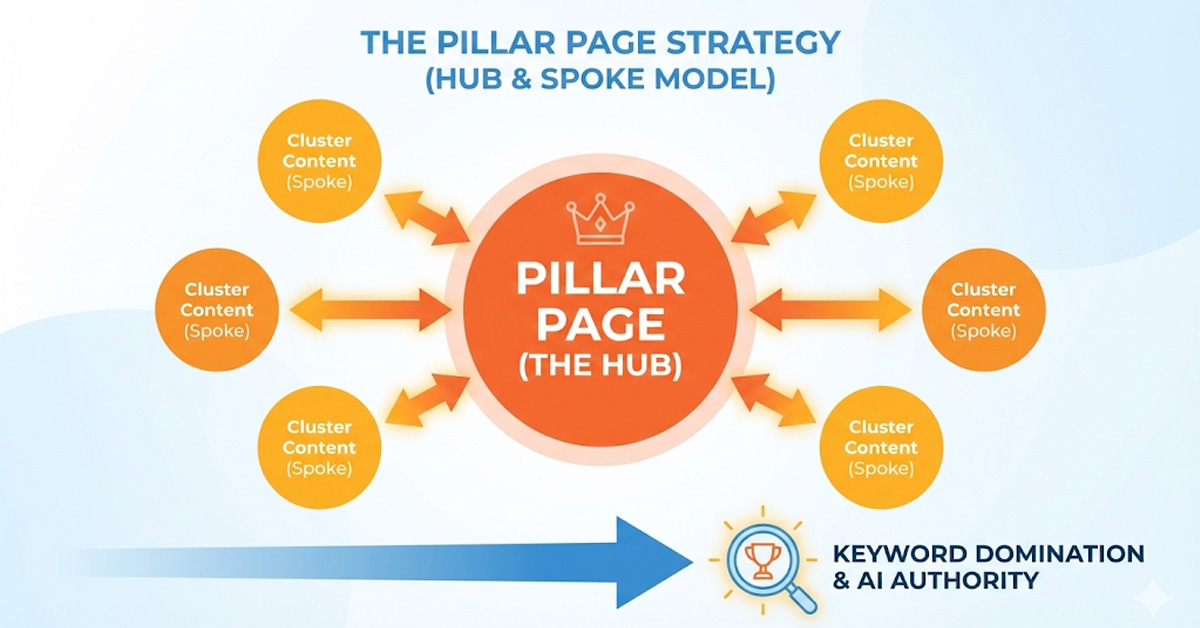
Think of your website like a wheel.
-
The Hub (Pillar Page): The center of the wheel. It covers a broad topic (e.g., "The Complete Guide to SEO").
-
The Spokes (Cluster Content): The supporting arms. These are specific articles answering narrow questions (e.g., "How to do Keyword Research," "What is a Backlink").
-
The Rim (Internal Links): The connection point. Every Spoke links back to the Hub, and the Hub links out to every Spoke.
This structure tells Google: "We are not just writing random articles. We own this entire topic."
The 3 Types of Pillar Pages That Work in 2026
Not all Pillars are the same.
Choose the format that matches your user's intent.
1. The "10x Content" Guide
This is the classic "Ultimate Guide." It is usually 3,000+ words and covers "The What," "The Why," and "The How."
-
Best For: Broad informational keywords (e.g., "Content Marketing Strategy").
-
Structure: Introduction $\rightarrow$ Table of Contents $\rightarrow$ Chapter 1 (Link to Sub-Post A) $\rightarrow$ Chapter 2 (Link to Sub-Post B).
2. The "Resource" Pillar
This is a curated library of links and tools.
It's less about writing paragraphs and more about organizing data.
-
Best For: "Best of" queries (e.g., "Best AI Tools for Business").
-
Structure: A list of 50 tools, categorized by use case, with links to detailed individual reviews.
3. The "Product" Pillar (The Category Page)
For e-commerce, your Category Page is your Pillar.
-
Best For: Commercial intent (e.g., "Buy Men's Running Shoes").
-
Strategy: Don't just list products. Add 500 words of FAQ content at the bottom and link to "Buying Guides" in your blog to build semantic relevance.
The "Golden Thread" Linking Strategy
The magic of a Pillar Page isn't the content length; it's the Internal Linking.
If you write a massive guide but fail to link it to your sub-articles, it's just a lonely long-form post.
You must stitch the cluster together.
Step 1: Link OUT from the Pillar
In every section of your Pillar Page, link to the specific "Cluster Article" that explains that concept in depth.
-
Anchor Text Example: "For a deeper dive, read our step-by-step guide on keyword research techniques."
Step 2: Link BACK to the Pillar
This is the step most SEOs forget.
You must go into every single sub-article and link back to the Pillar Page using descriptive anchor text.
-
Anchor Text Example: "This is just one part of our comprehensive SEO Strategy Guide."
Step 3: Verify the Connection
If a Spoke doesn't link to the Hub, the wheel breaks.
-
The Audit: Use the SEO Shouts Internal Link Checker.
-
The Check: Enter your Pillar Page URL. Look at the "Incoming Links" count. If you have 20 cluster articles but only 5 incoming links, you have "orphaned spokes." You need to go back and add those links immediately.
Optimizing Pillar Pages for AI Overviews
AI bots love Pillar Pages because they are structured data goldmines.
To ensure your Pillar gets cited:
-
Use a "Clickable" Table of Contents: Jump links help bots navigate the long content.
-
Define the Entity Early: In the first H2, clearly define the topic (e.g., "What is Technical SEO?"). This creates a "Definition Vector" for the AI.
-
Update Frequently: A Pillar Page is never finished. Update it quarterly with new links to your latest blog posts.
Conclusion: Stop Building Islands, Build Cities
A random blog post is an island.
A Pillar Page is a city-connected, bustling, and authoritative.
If you want to dominate competitive keywords in 2026, stop writing isolated articles. Start building Pillars.
Is your Pillar Page actually connected?