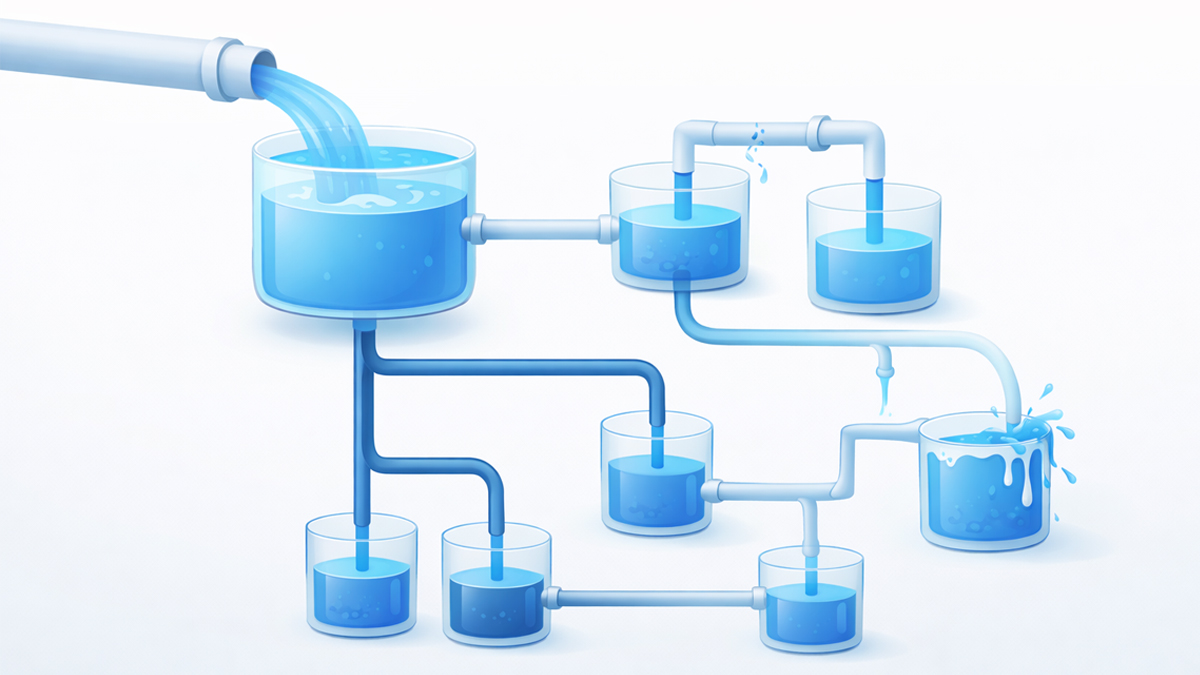
In the era of "10 Blue Links," internal linking was a simple game of plumbing: you connected Pipe A to Pipe B to pass "PageRank."
But in 2026, the game has fundamentally changed. With the dominance of Google AI Overviews (AIO), ChatGPT Search, and Perplexity, internal links are no longer just about passing authority-they are about defining Entities.
Search engines today don't just "index" links; they "read" them to understand the semantic relationship between concepts. If your internal linking structure is weak, AI models cannot "connect the dots" of your expertise, leaving your content out of the conversation.
This guide covers the modern "AI-First" strategy for internal linking, including Entity Mapping, Natural Language Anchors, and how to audit your site architecture for the age of Zero-Click Search.
The 2026 Shift: From "Keywords" to "Entity Connections"
For two decades, SEOs visualized websites as hierarchies. Today, you must visualize your website as a Knowledge Graph.
How AI Models "Read" Your Links
Large Language Models (LLMs) operate on Vector Embeddings. They analyze how closely related two concepts are in a multi-dimensional space.
-
Old SEO (2020): Linking "Dog Food" to "Cat Food" because they are both products.
-
AI SEO (2026): Linking "Dog Food" to "Can Dogs Eat Grain?" because they share a semantic relationship that answers a user's intent.
When you link two pages internally, you are training the AI. You are explicitly telling it: "Page A (The Concept) is trusted by Page B (The Source)." Without these connections, your pages exist in isolation-invisible to the "Answer Engines" that power modern search.
The Strategy: The "Topic Cluster" Model (Building Your Knowledge Graph)
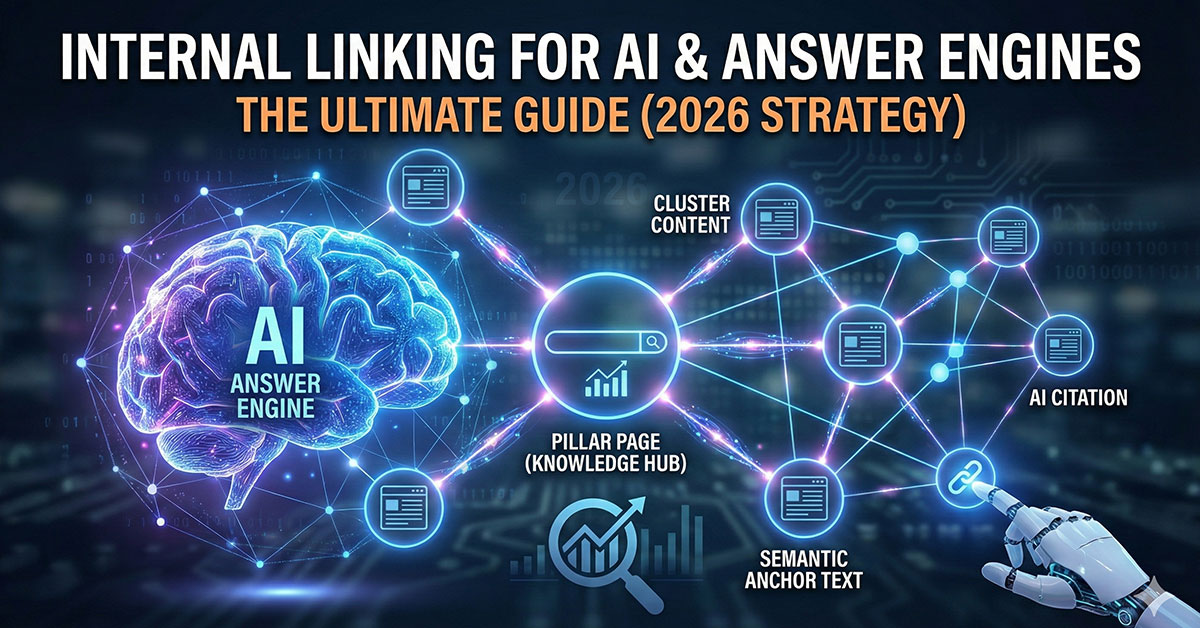
The most effective way to structure a site for 2026 is the Topic Cluster model. This moves away from random blogging into a clean, authoritative hierarchy that AI bots crave.
1. The Pillar Page (The Hub)
This is your "Source of Truth"-a comprehensive guide covering a broad entity (e.g., "Technical SEO"). It targets broad, high-volume intents.
2. The Cluster Content (The Spokes)
These are supporting articles that answer specific questions (e.g., "How to Fix 404 Errors," "What is XML Sitemap").
3. The "Semantic Thread" (The Links)
-
Pillar to Cluster: The main guide links out to every sub-topic, defining the scope of the entity.
-
Cluster to Pillar: Every sub-topic links back to the main guide, voting for its authority.
-
Cluster to Cluster: Related sub-topics link to each other, creating a tight "web" of relevance.
Why this wins in 2026: When an AI bot (like GoogleOther) lands on your "Hub," it instantly finds links to 20+ deeply related articles. This signals Topical Authority, increasing the probability that your content will be cited in an AI Overview.
Semantic Anchor Text: Writing for the "Reasoning" Engine
The text you use to link two pages (the Anchor Text) is the primary context signal for AI. However, the rules have evolved.
The Death of "Click Here"
Using generic anchors like "Click here" or "Read more" is now a critical error. It gives the AI zero context vector. It tells the bot: "The target page is about... nothing."
The Risk of Over-Optimization (Penguin 2.0)
Conversely, using the exact same keyword 100 times (e.g., linking every instance of "SEO Tool" to your homepage) looks robotic. In 2026, AI algorithms are trained to detect and ignore unnatural patterns.
The Solution: "Natural Language" Anchors
The best anchor text in 2026 describes the destination in conversational language.
-
Bad: "Best SEO Tool" (Repeated 50x)
-
Good: "...use a free tool to visualize your link structure to see..."
-
Good: "...audit your site with an anchor text checker..."
Pro Tip: Not sure if you are over-optimized? You need to visualize your data. The SEO Shouts Internal Link Anchor Text Checker generates a Word Cloud of your links. If one commercial keyword dominates the cloud, you are at risk of being ignored by AI filters.
Technical Health: Ensuring AI Can Crawl Your Links
Even the best strategy fails if the technical infrastructure is broken. AI crawlers have limited patience (Crawl Budget). If they hit dead ends, they stop learning about your site.
1. Broken Internal Links (404 Errors)
A link pointing to a non-existent page is a "trust killer." It tells the AI, "This knowledge graph is broken."
-
The Fix: Regularly scan your site for 404 codes. Update the link to a relevant live page or remove it.
2. Orphan Pages (The Invisible Content)
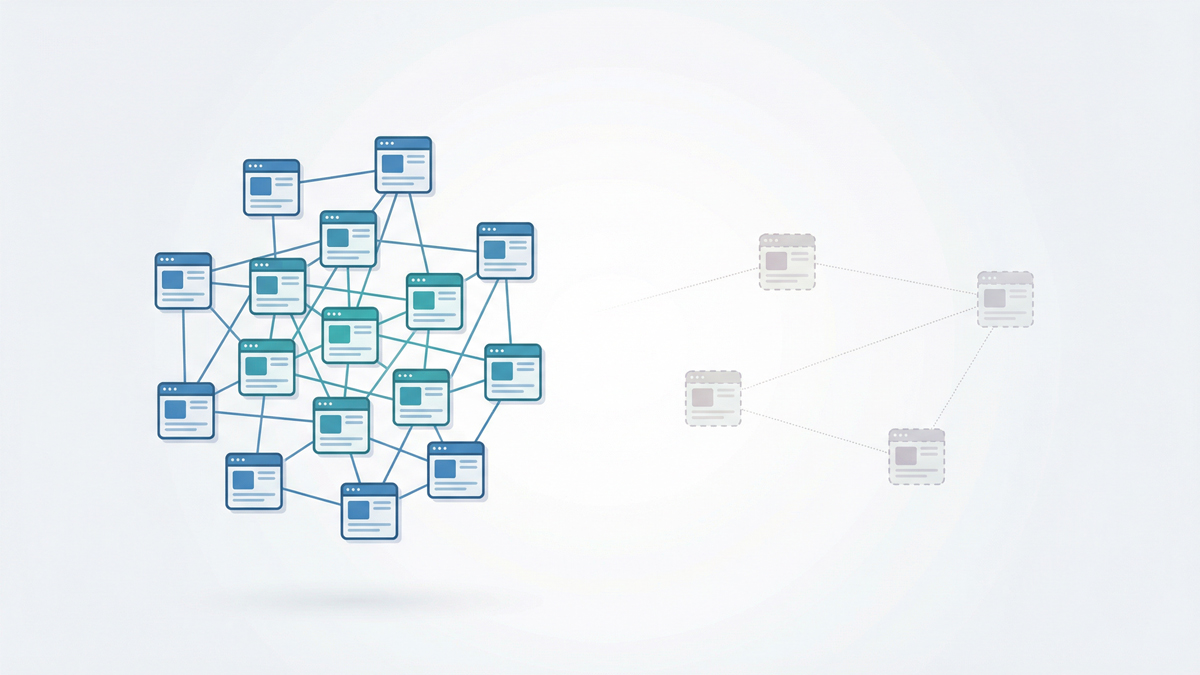
An Orphan Page is a page that exists in your database but has zero internal links pointing to it.
-
The AI Problem: If you don't link to it, the AI assumes it is unimportant. Orphan pages are rarely cited in AI answers because they lack "Internal PageRank."
-
The Solution: Cross-reference your Sitemap with your Link Graph. (Our Free Internal Link Tool can help you identify pages that are receiving zero incoming links).
3. Click Depth (Flat Architecture)
Important content should never be buried. The 3-Click Rule remains vital: No page should be more than 3 clicks away from your homepage.
-
Homepage > Category > Sub-Category > Article.
-
If a bot has to click 6 times to find your article, it de-prioritizes that page in its training data.
Internal Linking Audit Checklist (2026 Edition)
Ready to optimize your site for the Answer Engines? Follow this step-by-step workflow.
Step 1: Map Your Link Structure
You cannot fix what you cannot see. Use a crawler to map your entire semantic structure.
-
Tool: Use the SEO Shouts Internal Link Checker. It crawls up to 500 URLs for free and requires no login.
Step 2: Analyze the "Word Cloud"
Look at the Anchor Text Cloud in the report.
-
Diversity Check: Do you see a natural mix of brand names, entity variations, and long-tail phrases?
-
Spam Check: Is a single "money keyword" significantly larger than everything else? If so, dilute it with natural language variations.
Step 3: Identify & Fix 404s
Filter the report by Status Code: 404.
-
Action: Immediately update these links. Dead links are the fastest way to lose "Crawl Trust."
Step 4: Check for "Nofollow" Tags
Filter by Rel: Nofollow.
-
Action: Unless you are linking to a login page or user admin area, remove the nofollow tag. Internal links should almost always be dofollow to let authority and context flow freely.
Step 5: Reconnect Your Orphans
Check your CMS for pages that didn't appear in the crawl.
-
Action: Go to your most authoritative "Hub" pages and add a link to these orphan pages to bring them into your Knowledge Graph.
Conclusion: Link with Intent
Internal linking is no longer a "set it and forget it" task. It is the framework that holds your entire digital presence together.
By shifting your focus from "keyword matching" to "Entity Association," you build a website that is future-proof. You create a structure that helps humans navigate your content and helps AI chatbots understand your authority.
Ready to visualize your site's structure? Don't guess. Run a Free Internal Link Audit Now and see your site through the eyes of an AI.