In SEO, "Links" are everything.
But not all links are created equal.
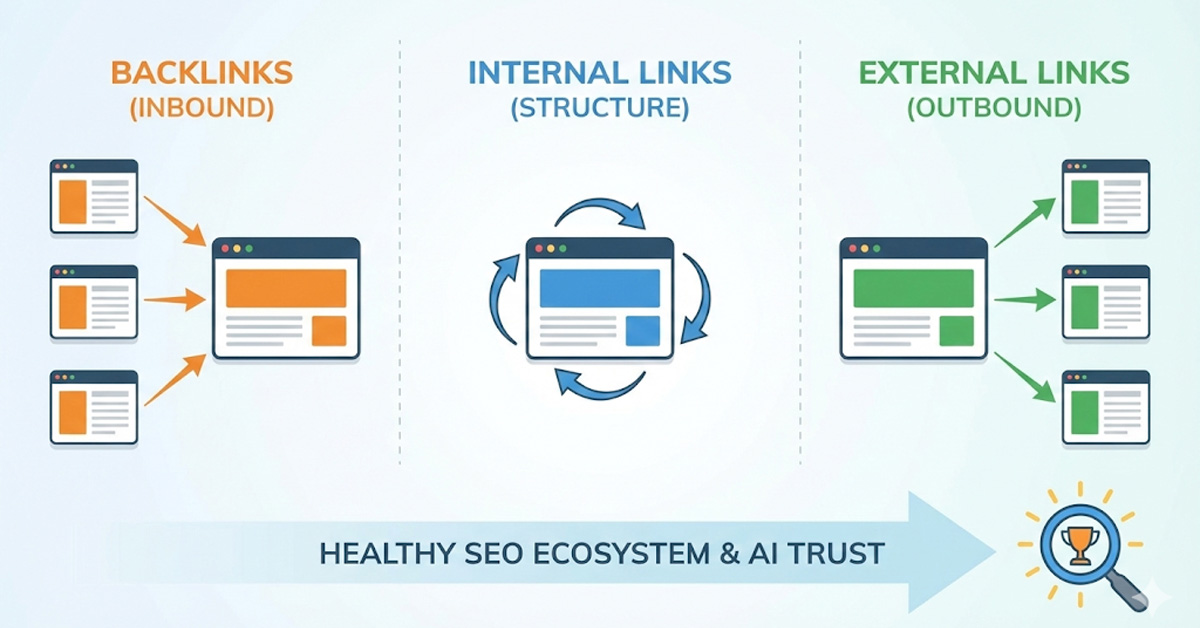
If you read SEO forums, you hear terms like "Backlinks," "Outbound Links," and "Internal Links" thrown around constantly.
It's easy to get confused.
- Do I need more backlinks?
- Should I link to other websites?
- Why do my internal links matter?
In the age of AI Search, understanding the difference is no longer just about vocabulary-it's about survival.
Search engines like Google and Perplexity use these three types of links to calculate your Trust Score.
This guide breaks down the "Three Pillars of Connectivity," explains the difference between them, and reveals which one gives you the highest ROI in 2026.
1. Internal Links (The Nervous System)
Definition: A link from Page A on your site to Page B on your site.
The Role: Structure and Context. Think of your website as a body. Internal links are the nervous system.
They connect your brain (Homepage) to your limbs (Blog Posts).
Without them, your site is just a pile of disconnected parts.
Why AI Loves Them: AI models use internal links to map your Knowledge Graph.
They follow the paths you create to understand how your topics relate.
- Control: You have 100% control over these.
- Strategy: By using Topic Clusters, you can tell the AI exactly which pages are most important.
Pro Tip: Use the SEO Shouts Internal Link Checker to visualize your "Nervous System" and ensure there are no broken connections.
2. External Links (The Citations)
Definition: A link from your site to a different website (also called "Outbound Links").
The Role: Trust and Verification. Many SEOs are scared to link out because they don't want to lose "link juice."
This is a mistake in 2026.
Why AI Loves Them: AI Answer Engines act like librarians.
They trust content that cites its sources.
- If you write an article about "Medical SEO" and link to the Journal of Medicine or Google's Search Central documentation, you signal that you have done your research.
- If you link to nothing, you look like a content farm.
The Strategy: Link out to authoritative, non-competing sources to validate your claims. It builds E-E-A-T (Experience, Expertise, Authoritativeness, Trustworthiness).
3. Backlinks (The Votes)
Definition: A link from a different website pointing TO your site (also called "Inbound Links").
The Role: Popularity and Authority. This is the holy grail of traditional SEO.
When a high-authority site (like Forbes or TechCrunch) links to you, it counts as a vote of confidence.
Why AI Loves Them: Despite the rise of content analysis, Backlinks remain a primary ranking factor.
According to Moz's detailed guide on backlinks, these inbound links tell search engines: "Other humans trust this source, so you should too."
The Problem: You have zero direct control over backlinks. You have to earn them through PR, outreach, or creating viral content.
The "Trust Triad": How They Work Together
Here is the secret sauce. You cannot win with just one type.
You need all three working in harmony.
- Backlinks bring the "Raw Authority" (Link Juice) into your site.
- Internal Links distribute that authority to your deep pages (via Pillar Pages).
- External Links validate your content, ensuring the authority sticks.
The Metaphor:
- Backlinks are the Fuel you put in the car.
- Internal Links are the Engine that moves the car.
- External Links are the GPS that proves you know where you are going.
If you have great Backlinks (Fuel) but broken Internal Links (a busted Engine), your site goes nowhere.
Which Link Type Has the Highest ROI?
- Backlinks are the most powerful, but they are expensive and hard to get.
- External Links are easy, but have a low direct impact on rankings.
- Internal Links are the sweet spot.
Internal Linking is the highest ROI activity in SEO.
Why? Because you control it completely.
You can double your traffic today simply by fixing your internal structure, repairing broken paths, and optimizing your anchor text-all without spending a dollar or sending a single outreach email.
Summary: The Ecosystem Checklist
To dominate the SERPs in 2026, ensure your ecosystem is balanced:
- Backlinks: Earn them by creating data-driven content.
- External Links: Include 2-3 citations per article to build trust.
- Internal Links: The most critical step. Audit them monthly.
Is your ecosystem healthy?
Start with the links you control. Audit your internal link structure for free.