In the early days of SEO, anchor text was a blunt instrument. If you wanted to rank for "Best Coffee Maker," you simply blasted that exact phrase into every internal link on your site.
But in 2026, that strategy is not just obsolete-it's dangerous.
With the rollout of Google's MUM (Multitask Unified Model) and the dominance of AI Overviews, search engines have evolved from "keyword counters" to "readers." They use Natural Language Processing (NLP) to understand the intent and context behind a link.
This is the era of Semantic Anchor Text.
If your internal links still read like a robotic list of keywords, you are confusing the AI models trying to rank you. This guide will teach you how to write anchor text that humans click and AI bots understand.
How AI Understands Links (NLP Explained)
To master anchor text in 2026, you must understand how Google reads it.
Modern algorithms don't look at anchor text in isolation. They use Vector Embeddings to analyze the relationship between words.
-
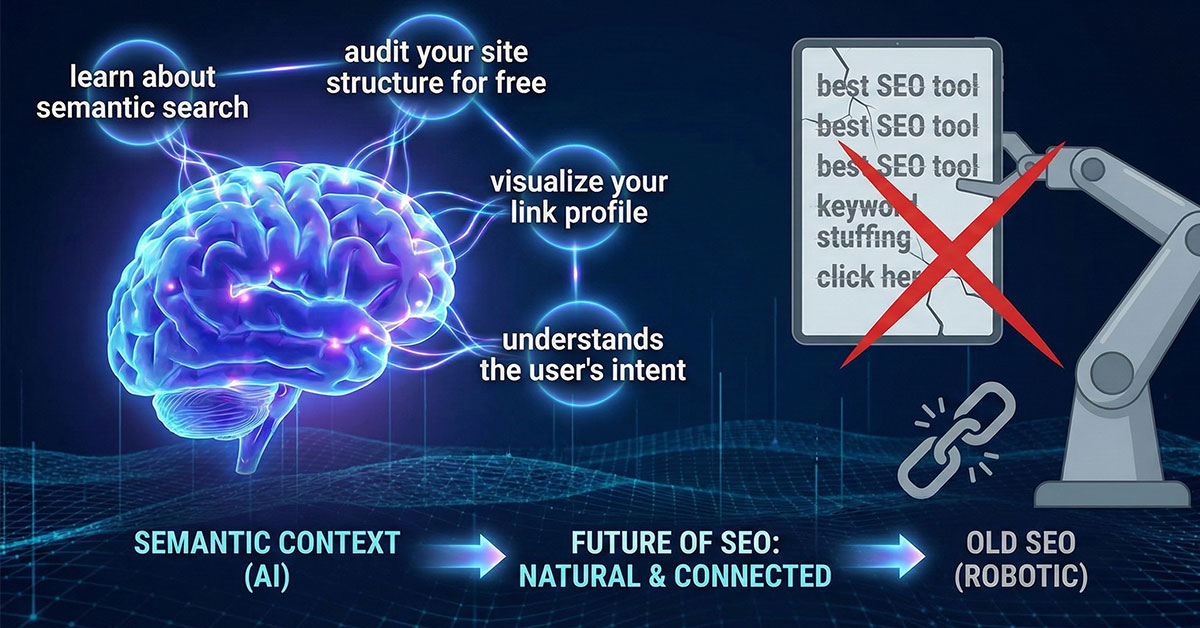
The Old Way: Google sees the words "Blue Shoes." It looks for pages with the "Blue Shoes" tag.
-
The AI Way: Google analyzes the sentence: "If you are running a marathon in the rain, check out our waterproof footwear."
Even though the anchor text might just be "waterproof footwear," the AI understands the vector connection to "running," "marathon," and "rain."
The Takeaway: Your anchor text must be part of a natural sentence. It acts as a bridge of meaning, not just a bridge of traffic.
"Keyword Stuffing" vs. "Natural Language Phrasing"
The biggest mistake SEOs make today is sticking to 2010 tactics.
The "Exact Match" Trap
Old Tactic: You write a paragraph and awkwardly shove a keyword in.
"We offer the best SEO audit tool for small businesses who want a free SEO audit tool to check their site."
Why AI Hates This: It reads as spam. The repetition lowers the "confidence score" of the text. It signals to Google that you are trying to manipulate the algorithm rather than help the user.
The "Natural Language" Approach
New Strategy: You write a sentence that describes the value or action.
"To identify structural issues without paying a subscription, you can audit your site structure for free using our tool."
Why AI Loves This: It provides context. It tells the AI why a user would click (to identify issues/save money). This matches the conversational nature of queries in ChatGPT or Gemini.
Analyzing Your "Anchor Cloud" for Over-Optimization
How do you know if you've crossed the line into spam? You need to visualize your link profile.
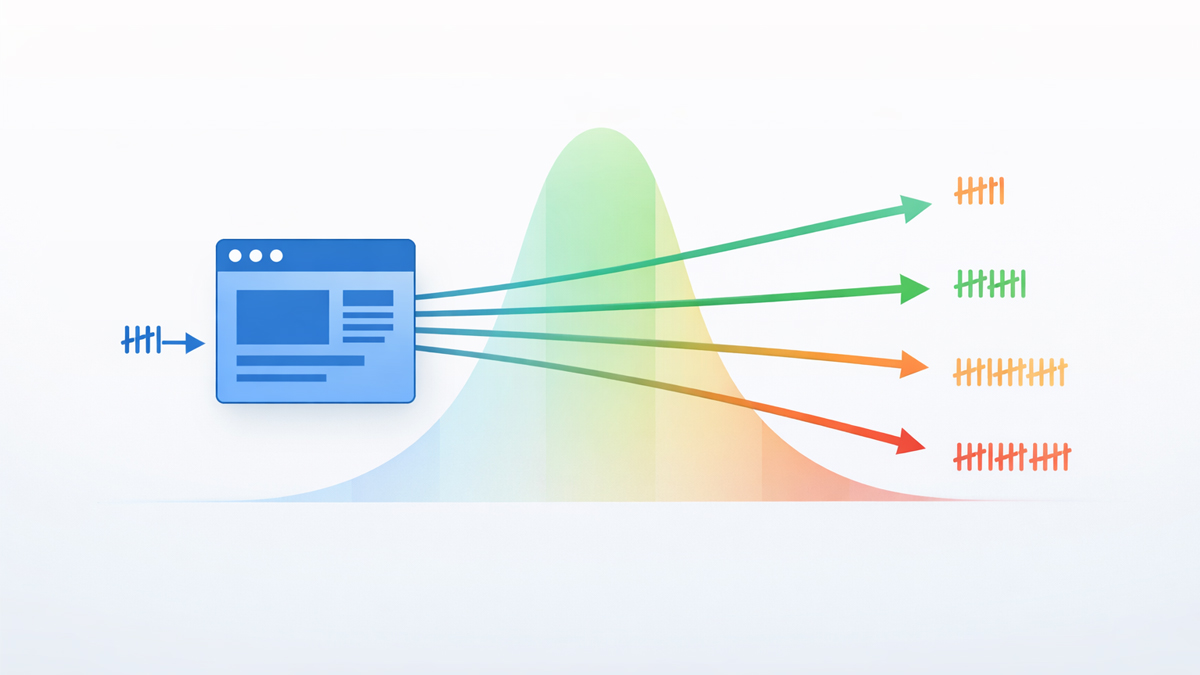
If 80% of your internal links use the exact same phrase (e.g., "Cheap Laptops"), you are waving a giant red flag at Google's Penguin algorithm. This is often invisible if you are just looking at a spreadsheet.
The Power of Visualization
This is why we built the Anchor Text Word Cloud.
Pro Tip: Before you build another link, run your site through the SEO Shouts Internal Link Anchor Text Checker.
Look at the generated cloud:
-
Healthy Cloud: A mix of large words (brand names) and many smaller, diverse words (variations, long-tail phrases).
-
Toxic Cloud: One massive "Money Keyword" dominating the screen.
If you see a Toxic Cloud, you need to go back and "dilute" those links. Change 20-30% of them to natural, descriptive phrases.
The New Rules of Anchor Text Ratios (2026)
While there is no "perfect" math, analyzing top-ranking sites in the AI era reveals a clear pattern. Aim for a profile that looks like this:
| Anchor Type | Example | 2026 Target % | Role in AI SEO |
| Descriptive / Semantic | "learn more about semantic search" | 50-60% | Provides context vectors for AI. |
| Branded | "According to SEO Shouts..." | 20% | Builds Entity Trust and Authority. |
| Exact Match | "Internal Link Checker" | 10-15% | Signals the core topic (Use sparingly). |
| Naked URL | "https://seoshouts.com" | < 5% | Low value, but looks natural in citations. |
| Generic | "Click here" | 0% | Avoid. Confuses AI models. |
Optimizing for AI Overviews (AIO)
Getting cited in Google's AI Overview (the AI summary at the top of search results) is the new #1 ranking spot.
AI models prioritize content that is easy to summarize and verify. Your anchor text plays a huge role here.
The "Definition" Link
When you link to a complex term, use anchor text that implies a definition is coming.
-
Example: "...which creates a [semantic gap (see definition)] in your content."
-
This helps the AI understand that the linked page is the "Source of Truth" for that definition.
The "Entity" Link
Always link the full name of an entity at least once.
-
Instead of: "The tool checks links..."
-
Use: "The SEO Shouts Internal Link Checker analyzes..."
-
This reinforces the connection between the "Product" (Entity) and the "Brand" (Entity) in the Knowledge Graph.
Conclusion: Write for the User, Optimize for the Bot
The golden rule of Semantic Anchor Text is simple: If you read the sentence aloud and it sounds robotic, change it.
Google's AI is trained on human speech. The more natural your internal linking sounds, the easier it is for the algorithm to understand your expertise. Stop counting keywords and start building context.
Is your anchor profile natural or robotic?
Don't guess. Generate your Free Anchor Text Cloud now and see exactly what the AI sees.