WebMCP (Web Model Context Protocol) is a browser-level API launched by Google on February 10, 2026, that allows websites to expose structured, callable tools directly to AI agents through Chrome.
Instead of AI agents scraping and guessing, websites now declare exactly what they can do. SEO experts are calling it the biggest shift in technical SEO since structured data — and the birth of "Agentic SEO."
Here's everything you need to know: what WebMCP is, how it works technically, how it differs from Anthropic's MCP, why SEO will never look the same, and what to do about it right now.
What Is WebMCP?
WebMCP stands for Web Model Context Protocol.
It's a proposed web standard — co-developed by Google and Microsoft engineers, incubated through the W3C Web Machine Learning Community Group — that introduces a new browser API: navigator.modelContext.
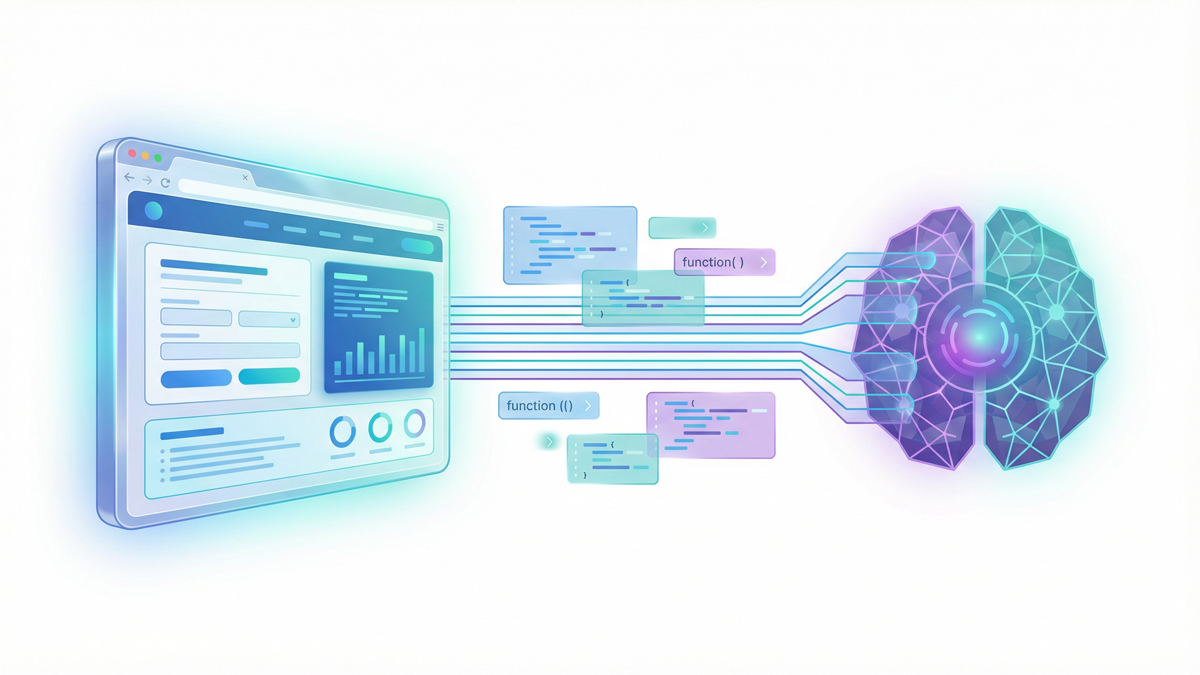
Through this API, a website publishes a structured "Tool Contract" describing its capabilities as callable functions.
An AI agent visiting the site can instantly see: here are the available actions, here are the parameters each action needs, and here is the data format returned.
The problem it solves is fundamental.
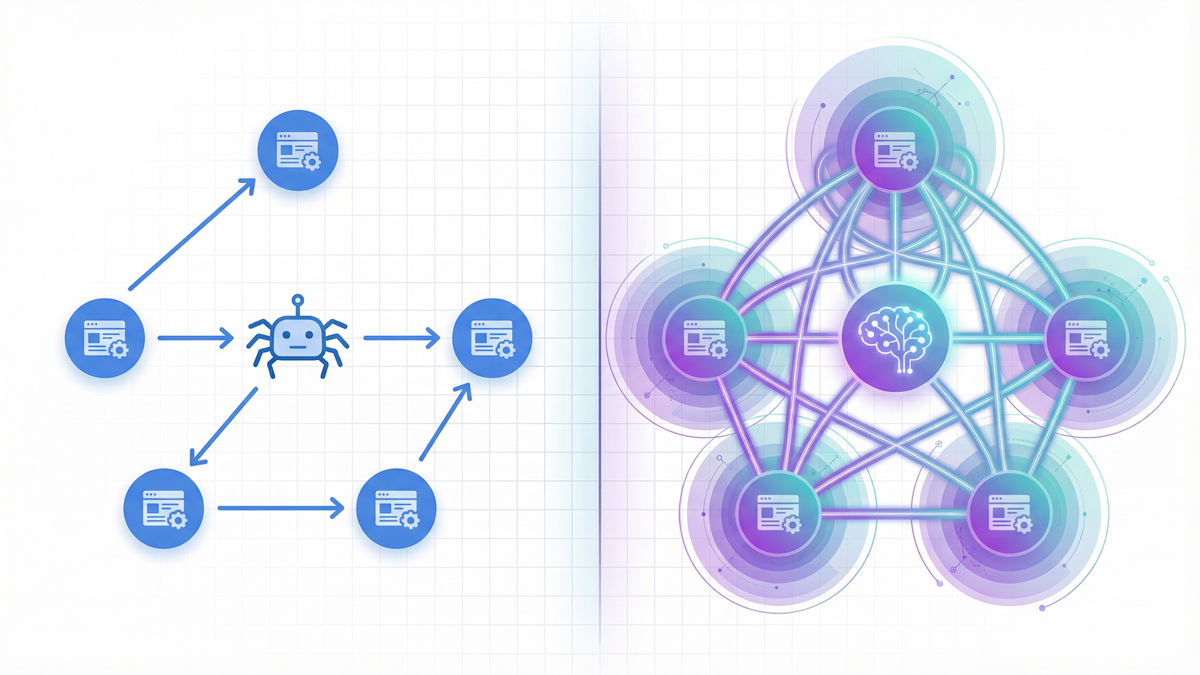
Today, AI agents interact with websites the same way a blindfolded person navigates a room — by taking screenshots, running them through vision models, and guessing which pixel to click.
This approach is slow, brittle, expensive, and breaks constantly when designs change.
Google's Staff Developer Relations Engineer André Cipriani Bandarra wrote in the official Chrome blog announcement that WebMCP provides a standard way for websites to expose structured tools so AI agents can act with increased speed, reliability, and precision.
A Google spokesperson told Adweek it provides the connection AI agents need for performing complex tasks on the open web.
The analogy from VentureBeat's coverage is apt: WebMCP aims to become the USB-C of AI agent interactions — one standardized interface replacing today's chaos of custom scraping.
How Does WebMCP Work Technically?
WebMCP offers two complementary approaches depending on how complex your website's actions are.
The Declarative API is for standard form-based actions. You add toolname and tooldescription attributes to your existing HTML <form> tags.
Chrome reads these and creates a schema AI agents can invoke.
Google's documentation notes that if your forms are already clean and well-structured, you're approximately 80% ready.
When an AI agent submits a form, a SubmitEvent.agentInvoked event fires, letting your backend distinguish machine requests from human ones.
Here's a simplified example of the Declarative API:
<!-- Before WebMCP: Standard HTML form -->
<form action="/search" method="GET">
 <input name="query" type="text" />
 <button type="submit">Search</button>
</form>
<!-- After WebMCP: Same form, now agent-callable -->
<form action="/search" method="GET"
 toolname="searchProducts"
 tooldescription="Search the product catalog by keyword, category, or price range">
 <input name="query" type="text" />
 <button type="submit">Search</button>
</form>
Two attributes. That's it for basic implementations.
The Imperative API handles complex, multi-step interactions needing JavaScript.
Developers call navigator.modelContext.registerTool() to expose functions with full JSON parameter schemas and natural-language descriptions.
This turns client-side code into a structured agent interface without needing separate backend infrastructure.
// Imperative API: Register a complex tool
navigator.modelContext.registerTool({
 name: "checkSEOScore",
 description: "Analyze a webpage for 100+ on-page SEO factors and return optimization scores",
 parameters: {
 type: "object",
 properties: {
 url: { type: "string", description: "The URL to analyze" },
 depth: { type: "number", description: "Crawl depth (1-5 pages)" }
 },
 required: ["url"]
 },
 execute: async (params) => {
 // Your tool logic here
 return await analyzeURL(params.url, params.depth);
 }
});
Key methods on navigator.modelContext include provideContext(options) for setting page context, clearContext() for removing it, registerTool(tool) for declaring capabilities, and unregisterTool(name) for removing them.
Two critical design principles matter for SEO professionals.
First, WebMCP is permission-first — Chrome mediates all tool execution and prompts users before sensitive actions happen.
Second, it's model-agnostic — any AI agent (Gemini, Claude, GPT, open source) can discover and use tools through a supporting browser.
Where Is WebMCP Available Right Now?
WebMCP is early-stage and experimental. Here's the current status as of February 2026:
| Detail | Status |
|---|---|
| Announced | February 10, 2026 (Chrome for Developers blog) |
| W3C Draft | February 12, 2026 (Draft Community Group Report) |
| Editors | Khushal Sagar (Google), Dominic Farolino (Google), Brandon Walderman (Microsoft) |
| Browser Support | Chrome 146 Canary only (behind experimental flag) |
| Access | Chrome Early Preview Program required for docs/demos |
| Spec Location | webmachinelearning.github.io/webmcp/ |
| Source Code | github.com/webmachinelearning/webmcp |
| Standards Status | NOT a W3C Standard — Draft with incomplete sections |
| Other Browsers | None yet (Microsoft co-authorship signals future Edge support) |
Industry observers expect formal broader browser announcements by mid-to-late 2026, likely at Google I/O or Chrome Dev Summit.
How Is WebMCP Different from Anthropic's MCP?
This is the most common point of confusion.
Despite sharing part of the name, they're fundamentally different protocols solving different problems.
| Anthropic's MCP | Google's WebMCP | |
|---|---|---|
| Launched | November 2024 | February 2026 |
| Type | Server-side backend protocol | Client-side browser API |
| Transport | JSON-RPC | Browser-native (navigator.modelContext) |
| Purpose | Connect AI platforms to external tools/data | Connect AI agents to web interfaces |
| Operates Where | Server infrastructure | User's browser session |
| Example | ChatGPT querying your database via API | AI agent booking a flight on your website |
| Requires | Backend server setup | HTML form attributes or JavaScript |
They're complementary, not competing.
A travel company might maintain a backend MCP server for direct API integrations with AI platforms while also implementing WebMCP tools on its consumer website for browser-based agents to interact with booking flows.
Google has embraced both protocols.
In December 2025, Google launched fully managed remote MCP servers for Google Maps, BigQuery, and other cloud services.
Google also co-maintains the official Go SDK for MCP, developed the Agent2Agent (A2A) Protocol for agent-to-agent communication, and built MCP support into its Agent Development Kit.
WebMCP sits on top of this broader stack as the browser-facing layer.
For SEOs already implementing AI crawler directives in robots.txt and structured data, understanding both protocols is essential — they represent two sides of the same coin in the agentic web.
Why SEO Experts Are Calling This a Paradigm Shift
The SEO community reacted fast and emphatically.
Dan Petrovic of DEJAN AI published a detailed analysis on the same day as the announcement, calling WebMCP the biggest shift in technical SEO since structured data was introduced.
His reasoning is compelling — and it's worth understanding why.
When search engines first needed to understand websites, an entire industry (SEO) emerged around providing structured signals: sitemaps, robots.txt, canonical tags, Schema.org markup.
Now AI agents need to interact with websites, and optimizing for that interaction is an entirely new discipline.
Petrovic identified implications that reframe SEO fundamentals:
Tool discoverability is the new indexing. Currently, there's no standard way for AI agents to discover which websites offer WebMCP tools without visiting them first. When search engines or agent directories eventually index these tool manifests, that will create an optimization surface as transformative as web search itself.
Tool descriptions are the new meta descriptions. The quality of your tool's name, description, and schema determines whether an AI agent selects it. Writing clear, specific tool descriptions becomes a core SEO competency — as important as writing meta descriptions was in 2010.
Schema design is the new structured data. The JSON parameter schemas you define for tools determine how precisely agents can use them. Poor schemas mean agents can't figure out your tool. Perfect schemas mean seamless execution.
Glenn Gabe called WebMCP a big deal.
Search Engine Land's Barry Schwartz noted that agentic experiences are shaping the future of search.
WordLift offered an elegant framing: if Schema.org markup provided the standardized nouns of the web, WebMCP provides the standardized verbs.
Kevin Indig's Growth Intelligence Brief positioned WebMCP as turning technical SEO into tool optimization.
The new term gaining traction across the industry: Agentic SEO — optimizing so autonomous AI agents can discover, understand, and execute actions on your website.
Multiple experts predict this becomes as important as mobile optimization was a decade ago.
How WebMCP Fits Into the Existing Web Standards Stack
WebMCP does not replace anything you've already built.
It adds a new layer on top. Here's how the full stack works together:
| Layer | Standard | What It Does | Status with WebMCP |
|---|---|---|---|
| Access | robots.txt | Controls which crawlers/agents can visit | Still essential — agents need access first |
| Discovery | XML Sitemaps | Tells search engines which pages exist | Still essential — no WebMCP discovery standard yet |
| Comprehension | Schema.org / Structured Data | Explains what a page IS (product, recipe, event) | Still essential — feeds the understanding layer |
| Content | llms.txt | Provides AI-readable site summary | Still useful — but WebMCP goes far beyond static text |
| Interaction | WebMCP | Declares what a page CAN DO (search, book, analyze) | NEW — the action layer |
Each layer is necessary. Removing any one weakens the entire chain.
The biggest gap right now is tool discovery.
The WebMCP spec acknowledges there's no standard mechanism for agents to know which sites offer tools without visiting first.
When this gets solved — through search engines indexing tool manifests, agent directories, or a new discovery protocol — it creates the next major optimization surface.
Think of it as the equivalent of when Google first started reading XML sitemaps.
What WebMCP Means for SEO Tool Websites
For websites like SEOShouts that offer free online tools, WebMCP represents a direct opportunity.
Our tools already perform structured actions — the Internal Link Checker crawls sites and returns link data with word cloud anchor text visualization, the On-Page SEO Analyzer audits pages against 100+ factors using the real Google PageSpeed API, the Schema Generator creates structured markup for 39+ types.
In a WebMCP-enabled future, these tools could expose their functionality as callable actions that AI agents invoke directly.
Instead of a user visiting the tool page, entering a URL, and reading the output, an AI agent could call analyzeOnPageSEO(url) or checkInternalLinks(domain, maxPages) and receive structured results instantly.
This fundamentally changes how tool-based websites compete.
The winning tools won't just have the best UI for humans — they'll have the best tool descriptions, the cleanest parameter schemas, and the most reliable structured outputs for machines.
For SEO professionals running technical SEO audits, this means your audit tools and processes eventually become callable functions in an agent ecosystem.
The agencies and tools that structure their services for this reality capture agent-driven traffic while others remain invisible.
What Should Website Owners Do Right Now?
WebMCP is experimental — Chrome Canary only, spec incomplete, security concerns unresolved.
But the directional signal is unmistakable. Here's the action plan organized by timeline.
Immediate Steps (Now Through Mid-2026)
Audit your HTML forms.
Clean, well-structured forms are the foundation of the Declarative API.
Every <form> on your site should have clear labels, descriptive field names, and proper validation.
Google's documentation says clean forms get you 80% of the way to WebMCP readiness.
If your contact forms, search boxes, and filter interfaces use semantic HTML, you're already ahead.
Strengthen your structured data. Schema.org markup remains critical for the discovery and comprehension layers.
Run your pages through the SEOShouts On-Page SEO Analyzer to check existing structured data completeness.
Ensure product data, pricing, availability, and service descriptions are machine-readable — this data feeds both traditional search and future agent interactions.
Map your website's callable actions.
Make a list of every action your website enables: search, filter, book, submit, calculate, generate, analyze, compare.
These are your potential WebMCP tools. Document what parameters each action needs and what data it returns.
This inventory becomes your implementation roadmap.
Review AI crawler access.
Ensure your robots.txt allows GPTBot, ClaudeBot, PerplexityBot, Google-Extended, and other AI crawlers.
Agents need to discover your site before they can use your tools. Block AI crawlers and you're invisible in the agentic web.
Strategic Preparation (Mid-2026 Onward)
Treat tool descriptions like conversion copy.
When you register a WebMCP tool, its name and description determine whether an AI agent selects it over a competitor's.
Practice writing clear, specific, action-oriented descriptions now.
Think of it as writing meta descriptions — but for machines making decisions.
Plan analytics for agent traffic.
WebMCP's SubmitEvent.agentInvoked event lets you distinguish AI agent interactions from human visits.
Start planning how you'll track, analyze, and optimize for this new traffic source.
Invest in machine-readable data.
Product specs, pricing tiers, service descriptions, availability — anything an AI agent might need to decide whether to use your tool or service should be structured and accessible.
What to Avoid
Don't rush production implementation.
The spec has incomplete sections. Security models are undefined. Wait for stable browser release before deploying to production.
Don't confuse WebMCP with Anthropic's MCP.
They serve different purposes. Implementing a backend MCP server is a separate (and also valuable) initiative from preparing for browser-based WebMCP.
Don't ignore it either.
The SEO professionals who understood structured data early gained years of competitive advantage. This moment has a similar structural shape.
The Bigger Picture: Two Webs Are Emerging
WebMCP represents something larger than a new API.
It's Google and Microsoft's joint bet that the web needs a dual interface — one for humans (visual UI) and one for machines (structured tools).
Today, the web is built almost entirely for human eyes.
AI agents are forced to interpret visual interfaces designed for people, which is like asking someone to read a book by photographing each page and running OCR — technically possible, but absurdly inefficient.
WebMCP proposes a parallel layer where websites speak directly to machines in structured terms. The visual interface still exists for humans.
But alongside it, a machine interface declares: here's what I do, here's how to ask me to do it, and here's what you'll get back.
This is the agentic web.
And the websites that define their actions first — with the clearest descriptions, the most useful tools, and the most reliable execution — will dominate this new surface the same way early SEO adopters dominated search rankings.
The protocol is young. The spec is incomplete.
But the institutional weight — two major browser vendors, W3C incubation, integration with Google's entire AI ecosystem — signals this isn't a side project.
This is the infrastructure of the next web.
Start preparing now.
The websites that are ready when WebMCP goes mainstream won't be scrambling — they'll be capturing.
Frequently Asked Questions
What is Google's WebMCP?
WebMCP (Web Model Context Protocol) is a browser-level API launched by Google on February 10, 2026, that lets websites expose structured, callable tools to AI agents.
Instead of agents scraping screenshots, websites declare their capabilities through navigator.modelContext in Chrome.
It's co-developed by Google and Microsoft and incubated at the W3C.
Is WebMCP the same as Anthropic's MCP?
No. Anthropic's MCP is a server-side backend protocol using JSON-RPC for connecting AI platforms to external tools.
Google's WebMCP is a client-side browser API for AI agent interactions with web interfaces.
They're complementary — a website could implement both: MCP for backend integrations and WebMCP for browser-based agent interactions.
How does WebMCP affect SEO?
WebMCP creates a new optimization discipline called "Agentic SEO." Websites need to optimize tool descriptions, parameter schemas, and action declarations for AI agents — not just content for search crawlers.
Dan Petrovic of DEJAN AI called it the biggest shift in technical SEO since structured data was introduced.
Can I implement WebMCP on my website today?
It's available only in Chrome 146 Canary behind an experimental flag.
The W3C spec is a draft with incomplete sections.
Production deployment is premature. But preparation is smart — clean up HTML forms, strengthen structured data, map your site's actions as potential tools, and join Google's Chrome Early Preview Program.
Does WebMCP replace robots.txt or Schema.org?
No. WebMCP adds a new interaction layer on top of existing standards.
Robots.txt controls access, sitemaps guide discovery, Schema.org provides comprehension of what pages are.
WebMCP adds the ability to declare what pages can do. All layers remain necessary and complementary.
What browsers support WebMCP?
As of February 2026, only Chrome 146 Canary supports WebMCP behind an experimental flag.
Microsoft's co-authorship of the W3C spec signals future Edge support.
No timeline exists for Firefox or Safari. Broader browser adoption is expected by late 2026 or early 2027.
Will WebMCP affect my search rankings?
Not directly — at least not yet. WebMCP is currently a browser API for AI agent interactions, not a Google Search ranking factor.
However, as AI-driven search (AI Overviews, Perplexity, ChatGPT Search) grows, websites that AI agents can interact with reliably will likely gain visibility advantages over those that remain interaction-invisible.