AI search tools and Google both read the sentence around a link. How to write concise anchors in context-rich sentences that ChatGPT and Google understand.
TL;DR: Anchor text for AI search works best as a short descriptive phrase inside a sentence that explains why the link exists, because both AI search tools and Google read the words around a link.
Google's link documentation says "the words before and after links matter." Ahrefs found branded anchors correlated 0.51 to 0.63 with brand visibility in ChatGPT and AI Mode.
The catch: no study has isolated internal anchor text as an AI citation factor.
Most advice on "anchor text for AI" claims that Google reads only the linked words while AI models read the whole sentence.
That is not quite right.
Google's own link documentation says "the words before and after links matter, so pay attention to the sentence as a whole." Both systems use context.
What AI search changes is how much a page's wording gets reused.
AI tools pull passages from pages and quote or summarise them, so a clear sentence around a link can end up inside an answer.
This guide covers what is known about how AI search tools read links, a rewriting framework, and an audit you can run today.
The Core Idea: Short Anchor, Rich Sentence
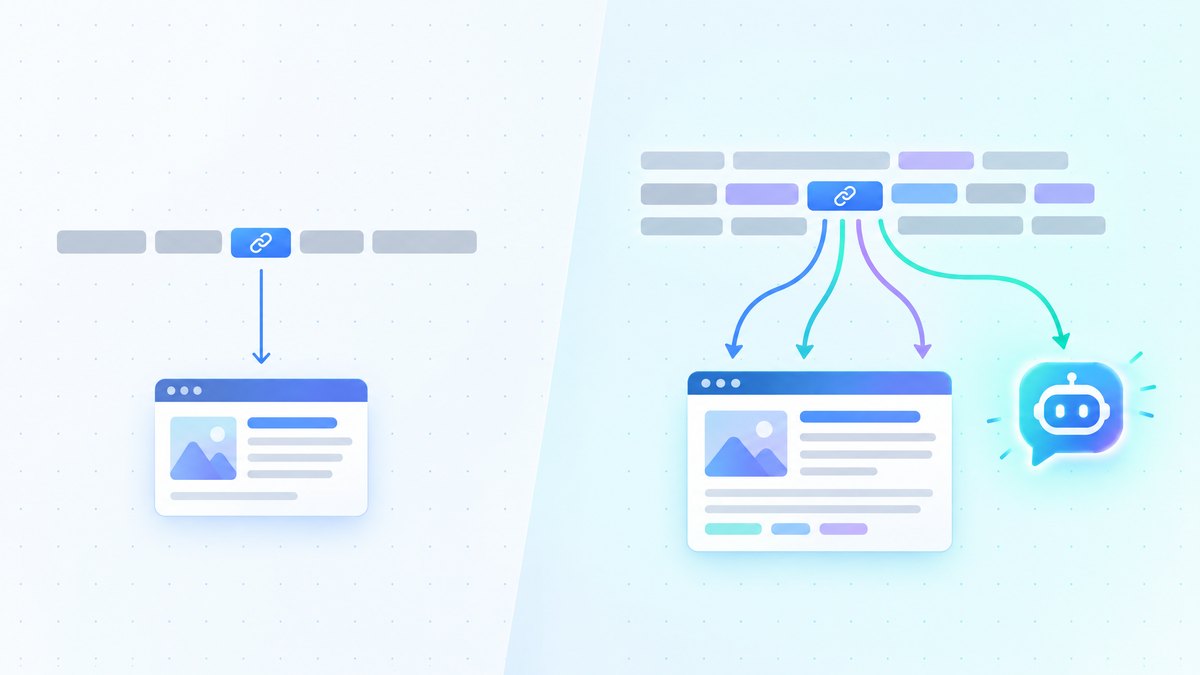
A link has two parts that carry meaning: the anchor (the clickable words) and the sentence around it.
Consider two internal links to the same tool page:
Version A (bare keyword): "Run an [internal link checker] to audit your site."
Version B (anchor in context): "If generic phrases like 'read more' dominate your links, the anchor text word cloud shows which words you overuse across up to 500 pages."
Both anchors are short.
Version B's sentence adds the problem (generic anchors), what the tool shows (word frequency), and its scope (500 pages).
A reader, Googlebot or an AI crawler learns far more about the destination from Version B.
What not to do is turn the whole sentence into the anchor.
Google's documentation labels a very long anchor "weirdly long" and asks for anchor text that is "reasonably concise." Keep the anchor tight and let the sentence do the explaining.
How AI Search Tools Read Your Links
AI search products do not publish how they weight anchor text, so treat any platform-specific percentage you read as a guess.
What can be stated from their documentation and public research:
They crawl with their own bots
OpenAI runs GPTBot for model training, OAI-SearchBot for ChatGPT search and ChatGPT-User for user requests.
Anthropic runs ClaudeBot, Claude-SearchBot and Claude-User.
Perplexity runs PerplexityBot.
These crawlers find pages by following links, so internal links still decide which pages they reach.
Most of them read raw HTML
A Vercel and MERJ study from December 2024 found that none of the major AI crawlers, including GPTBot and ClaudeBot, rendered JavaScript.
Links added by client-side scripts may be invisible to them.
Anchor text only helps if it is in the server-rendered HTML.
They retrieve passages, not just pages
AI answers are built from retrieved passages of text.
A link's anchor and its surrounding sentence sit inside those passages.
A sentence that clearly states what the linked page offers is easier to match to a question than a transition like "see more here."
Google AI Overviews and AI Mode
Google's AI features run on Google's own index, crawled by Googlebot, so normal anchor text best practice applies directly.
In October 2026 Google said it would place more inline links higher in AI Overview and AI Mode responses.
That makes it more likely that the pages you link clearly to each other show up as sources, though Google publishes no click data for these links.
Brand anchors and AI visibility
The strongest data point is about links from other sites, not internal links.
Ahrefs' study of about 75,000 brands (December 2025) found that branded anchors correlated with brand visibility at 0.628 in AI Mode, 0.511 in ChatGPT and 0.527 in AI Overviews.
Branded web mentions correlated even more strongly, while backlink counts correlated only weakly.
These are correlations, not proof of cause.
What Google and AI Search Have in Common
The table below compares what is documented for Google with what is reasonable to infer for AI search tools.
| Signal | Google (documented) | AI search tools (inferred) |
|---|---|---|
| Anchor words | Used to understand the linked page | Part of the retrieved passage |
| Words before and after the link | "Matter," per Google's docs | Part of the retrieved passage |
| Anchor length | "Reasonably concise"; very long is bad | No reason to differ |
| Generic anchors ("click here") | Named as too generic | Carry no information |
| Keyword-stuffed anchors | Against spam policies | No benefit |
| Varied anchors to one URL | Positive (Zyppy click data) | Describe more aspects of the page |
| Links in JavaScript only | Rendered by Googlebot | Often not seen (no JS rendering) |
| Branded anchors | Natural, low risk | Correlate with AI visibility (Ahrefs) |
The takeaway: writing anchors for AI search is the same discipline as writing them well for Google, with two extra checks.
Put links in server-rendered HTML, and make the sentence around each link state why the destination is useful.
The Anchor Text Rewriting Framework
A four-step process for turning bare keyword links into anchors in context.
Step 1: Name the Problem the Destination Page Solves
Before writing the link, ask what specific problem the destination page solves.
That answer becomes the sentence around the anchor.
For a link to the Internal Link Checker, the problem might be: "you can't see which anchor words dominate your site."
Step 2: Keep the Anchor Short and Descriptive
Keyword anchor: "use our internal link checker"
Descriptive anchor in context: "To see which keywords you over-link, use the anchor text word cloud."
The anchor stays at three or four words.
The sentence adds the outcome.
Step 3: Add Context Before and After
Weak version: "Check your links.
Use our [internal link checker].
Then fix issues."
Strong version: "Most sites only discover their anchors lean on generic phrases after a full crawl.
The anchor text visualisation shows the spread of every anchor on the crawled pages, so you can fix over-used phrases first."
Google's documentation also advises against placing links next to each other, because each link loses its surrounding text.
Give each link its own sentence.
Step 4: Vary Anchors to the Same URL
If ten pages link to your on-page SEO analyzer, give each link a different anchor that highlights a different aspect of the tool.
For example: "audit a page against 150+ SEO factors," "check Core Web Vitals alongside content," "spot missing schema before publishing" and "compare a page with top-ranking competitors."
Zyppy's study of 23 million internal links found that URLs with more varied internal anchors received more Google clicks.
Varied anchors also describe more of the page to any system reading your links.
Before and After: Real Anchor Rewrites
These examples use SEOShouts topics.
Example 1: Linking to the Robots.txt Generator
Before: "Update your [robots.txt] to allow AI crawlers."
After: "To let ChatGPT search, Claude and Perplexity reach your pages, add their search crawlers to your file with the robots.txt generator."
What changes: the sentence names the crawlers and the goal; the anchor stays short.
Example 2: Linking to the Anchor Text Optimization Guide
Before: "See our [anchor text guide] for more details."
After: "Working ranges for descriptive, branded and exact-match anchors are in the anchor text optimization guide, with data from a 23-million-link study."
What changes: the reader knows what they will find (ranges) and why to trust it (the study).
Example 3: Linking to the Orphan Pages Guide
Before: "Fix your [orphan pages] to improve crawling."
After: "Pages with no incoming internal links are hard for any crawler to find, so fixing orphan pages is often the quickest crawl win."
What changes: the sentence explains the mechanism and the benefit.
Each rewrite adds a few words to the sentence, not to the anchor.
Is There an "AI Anchor Text Ratio"?
No. There is no published ratio for AI search, and no evidence that AI tools need a different mix from Google.
Use the same internal link guardrails covered in the anchor text optimization guide:
| Anchor Type | Working Range (internal links) |
|---|---|
| Descriptive / partial match | 50 to 60% |
| Branded | 20 to 25% |
| Exact match | 10 to 15% |
| Naked URL | Under 5% |
| Generic ("click here") | Under 5% |
The practical change AI search pushes is getting generic anchors close to zero, because a "read more" link gives a retrieved passage nothing useful to say about the destination.
Use the word cloud in the SEOShouts Internal Link Checker to see your current mix.
If generic and URL anchors together make up more than about 10% of your profile, start there.
How to Audit Your Anchor Text for AI Search
A standard anchor audit looks for over-optimization.
An AI-focused audit asks whether each link explains its destination.
Run it in four steps:
- Crawl and export. Crawl your site with the SEOShouts Internal Link Checker and export the anchor list. If the biggest words in the cloud are "here," "this" or "read more," start rewriting.
- Count anchors per priority page. Sort anchors by destination. For the pages you most want cited, count the unique anchors. Fewer than three means your links describe that page narrowly.
- Read the sentences. For your top ten internal links, read the full sentence each anchor sits in. Does it say what problem the destination solves? If not, rewrite the sentence.
- Check the HTML. View the page source and confirm the links appear without JavaScript. If your related-posts block or navigation is built by scripts, AI crawlers may not see those links.
The on-page SEO analyzer can then check the destination pages themselves.
The Mistake to Fix First: Dead Sentences
The most common weak pattern is the dead sentence: a transition that exists only to carry a link.
Examples: "For more information, [click here]." "Learn more about [anchor text optimization]." "See our [guide to internal links]."
These tell readers and machines nothing about why the destination matters.
If a retrieval system pulls that sentence, it has nothing to work with.
The fix is to give the sentence a reason.
"For more information, click here" becomes "Sites that publish often lose track of which posts link to which, and the internal link audit checklist catches those gaps in about 30 minutes." Now the sentence carries a problem, a solution and an outcome.
AI Anchor Text Optimization Checklist
Run the Internal Link Checker first, then work through this list.
Anchor quality:
- Anchors are short descriptive phrases, not whole sentences
- Each anchor describes the destination, not just a topic word
- Links to the same URL use varied anchors
- Generic anchors (click here, read more, this post) are close to zero
Sentence context:
- Each link sits in its own sentence that explains why it is there
- Priority pages receive 3 or more internal links with different anchors
- No dead sentences that exist only to carry a link
- No links placed back to back without text between them
AI platform readiness:
- The AI search crawlers you want (OAI-SearchBot, Claude-SearchBot, PerplexityBot) are allowed in robots.txt
- Internal links are present in server-rendered HTML
- Schema markup is in place on key destination pages
- Topic clusters link both ways with varied anchors
Monitoring:
- Anchor word cloud reviewed monthly for generic anchor creep
- Regular prompt checks in ChatGPT, Perplexity, Claude, Gemini and Google AI Mode for your key topics
- New articles get reverse links with descriptive anchors from 3 to 5 existing pages
Frequently Asked Questions
Does anchor text matter for AI search engines?
Probably, but no published study has isolated it.
AI search tools retrieve passages of text, and a link's anchor and surrounding sentence are part of that passage.
Descriptive anchors in context-rich sentences describe the destination clearly, which helps both AI retrieval and Google.
What is natural language anchor text?
It is a concise, descriptive anchor placed inside a sentence that explains why the link is there.
For example: "If generic phrases dominate your links, the anchor text word cloud shows which words you overuse." The anchor stays short; the sentence carries the context.
Should anchor text be longer for AI search?
No. Google's link documentation asks for anchors that are reasonably concise and labels a very long anchor as a bad example.
Keep anchors to a short phrase and put the extra context in the words before and after the link.
What anchor text ratio works best for AI search optimization?
There is no separate AI ratio.
Use the same internal link guardrails as for Google: mostly descriptive anchors, some branded and exact match, and as few generic anchors as possible.
Replacing "click here" links is the change that matters most.
Can I use the same anchor text for multiple internal links to the same page?
Avoid it.
Repeating one anchor from many pages adds little new information about the destination.
Varied anchors that each describe a different aspect of the page give Google and AI tools a fuller picture of what it covers.
How do I know if my anchor text is AI-ready?
Run the SEOShouts Internal Link Checker and review the anchor word cloud.
If the largest words are "here," "this" or "read more," rewrite those links first.
Then read each link's sentence and check that the links appear in your page source without JavaScript.
Does optimizing for AI hurt my Google rankings?
No. Concise, descriptive anchors inside sentences that explain the link are exactly what Google's own documentation recommends.
The only things to avoid for both are stuffing anchors with keywords and making them very long.
Get More SEO Insights
Join 10,000+ marketers receiving weekly SEO strategies and tips directly in their inbox.