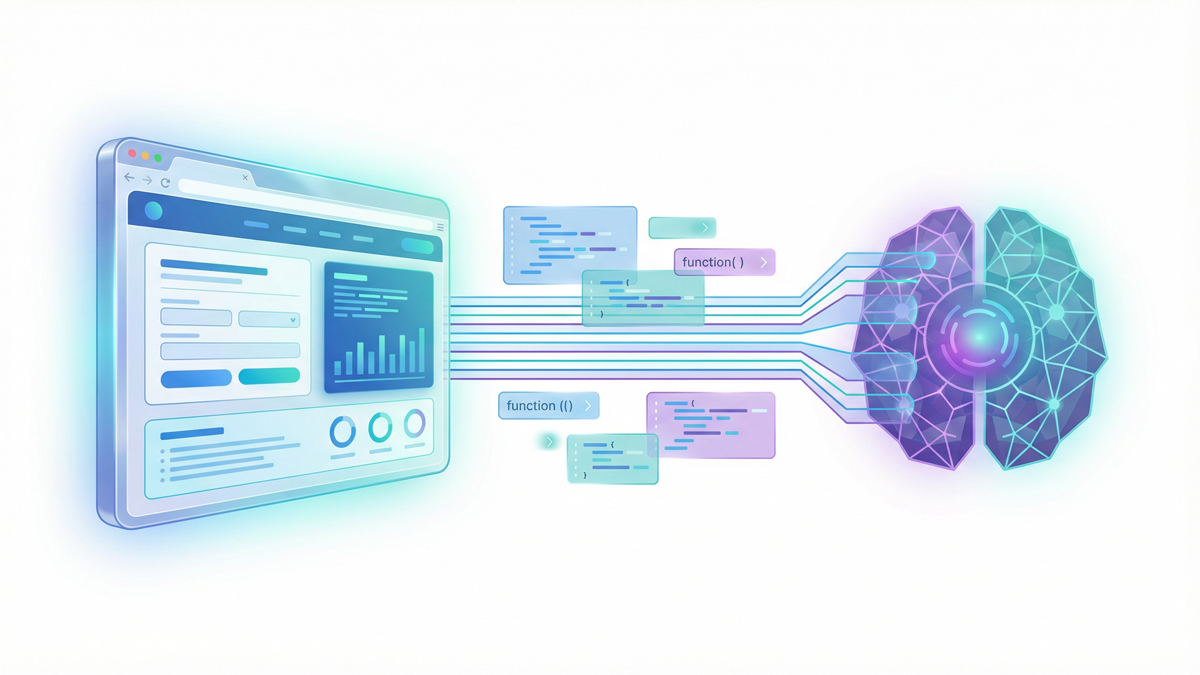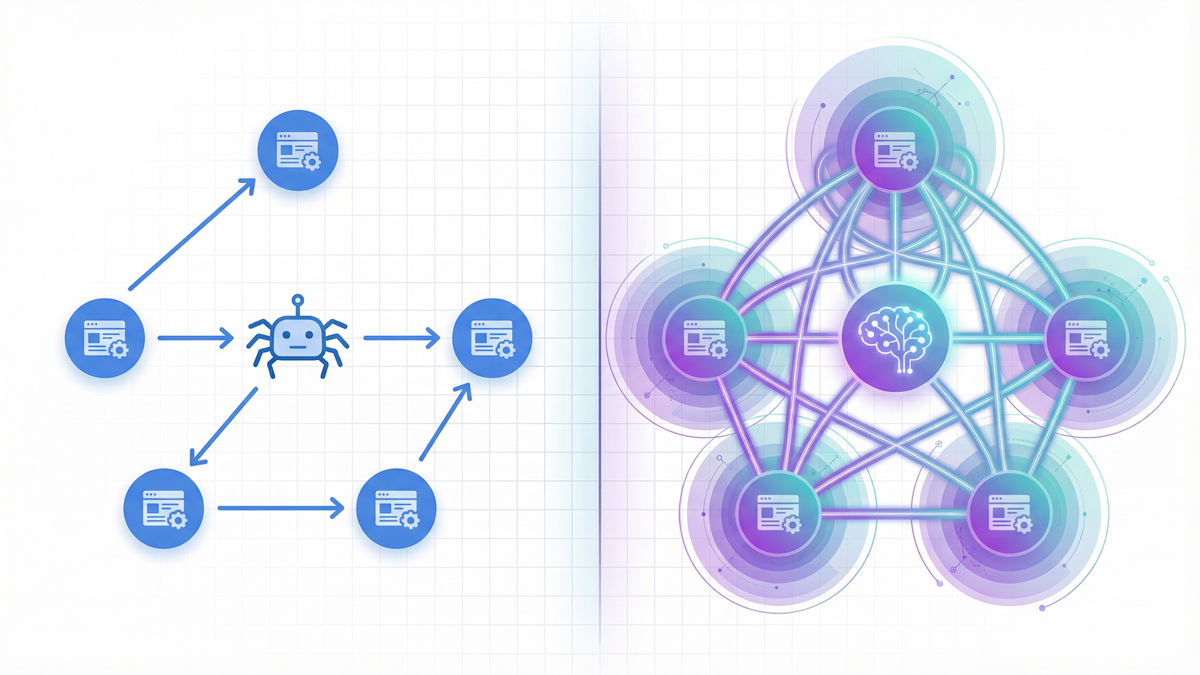
AI search engines like ChatGPT, Perplexity, and Gemini use your internal links to build semantic maps of your entire website, mapping how topics connect, which pages hold expertise, and what content deserves citation in AI-generated answers.
This goes far beyond how Google traditionally uses internal links.
This guide explains exactly how each major AI platform processes your internal links differently, what signals they extract from your link structure and anchor text, and how to optimize your internal linking strategy so AI search engines understand, trust, and cite your content.
How AI Search Engines Differ from Google in Processing Internal Links
Google's traditional crawler follows internal links primarily for three purposes: discovering pages, distributing PageRank, and understanding topical relationships through anchor text.
This has been the foundation of the internal linking strategy for two decades.
AI search engines do all of that — and then add a layer that changes everything.
When ChatGPT, Perplexity, or Gemini processes your site, their underlying language models don't just note that Page A links to Page B with anchor text "X."
They analyze the full semantic context: what the source page is about, what sentence surrounds the link, what the anchor text describes, and what the destination page covers.
From this, they build a vector-based understanding of how your topics relate to each other.
According to Yoast's internal linking research, internal links in the AI era "are no longer mere SEO signals, but context signals that shape how AI models understand your topics."
SEOClarity's research confirms that a strong internal linking structure gives AI engines clearer semantic signals for generative results.
Think of it this way: Google uses your internal links like a map legend; they show what exists and what connects. AI models use your internal links like a knowledge graph; they show what your site knows and how deeply it understands each topic.
This distinction has massive practical implications for your internal linking strategy.
How Each AI Platform Processes Your Internal Links
Not all AI search engines work the same way. Understanding the differences helps you optimize for maximum visibility across platforms.
ChatGPT (OpenAI)
ChatGPT uses two mechanisms to access your content.
Real-time search: When a user asks ChatGPT a question using its search feature, OAI-SearchBot crawls websites in real-time and pulls results from the Bing index.
Cloudflare's 2025 testing confirmed that OAI-SearchBot respects robots.txt directives when disallowed; it stops crawling and doesn't attempt alternative access methods.
Training GPTBot previously crawled the web to gather training data for OpenAI's models. Content in the training set can be referenced even without real-time crawling.
How internal links matter: ChatGPT's search relies heavily on Bing's index. If your pages aren't well-linked internally, they may not be indexed properly in Bing, which means ChatGPT can't find them during real-time search. Pages buried at crawl depth 4+ that struggle in Google are essentially invisible to ChatGPT.
ChatGPT also tends to prefer comprehensive content from domains with strong existing Bing rankings, fresh publication dates, and clear author attribution.
Your topic cluster architecture directly influences whether Bing (and therefore ChatGPT) considers your site authoritative on a topic.
Perplexity AI
Perplexity operates differently from ChatGPT in important ways.
Aggressive citation model: Perplexity typically includes 5-15 citations per answer, far more than ChatGPT. It favors specific, factually dense content with clear structure.
This makes Perplexity the platform where strong internal linking yields the most direct payoff, because it actively seeks niche-expert content that other platforms might overlook.
Faster indexing: Perplexity indexes new content quickly, so newly published pages have a faster path to citations than on ChatGPT.
When you publish a new cluster article and immediately link to it from 3-5 existing articles, Perplexity can discover it within hours through those link pathways.
Crawl behavior: Perplexity uses PerplexityBot as its declared crawler. However, Cloudflare documented in August 2025 that Perplexity sometimes uses undeclared crawlers to circumvent website blocking.
While controversial, this means Perplexity is likely to find and index your content even from deeper parts of your site, provided internal links create navigable pathways.
What this means for internal linking: Because Perplexity cites more sources and indexes faster, the quality of your anchor text matters more here than on any other platform.
Descriptive anchors that explain what the destination page covers give Perplexity the semantic context it needs to match your content with user queries.
Google AI Overviews & Gemini
Google's AI Overviews (and the standalone Gemini model) have a unique advantage: they already have Google's entire search index to work with.
The 99.5% overlap: Research shows that approximately 99.5% of sources cited in Google's AI Overviews come from pages already ranking in Google's top 10 organic results.
This means that everything you do to improve traditional Google rankings, including internal linking, directly increases your AI Overview visibility.
Semantic understanding through links: Google's BERT and MUM models analyze your internal link structure to understand topical relationships.
When five blog posts all link to your "technical SEO audit" service page using varied, descriptive anchor text, Google's AI builds strong confidence that you're authoritative on that topic.
Reasonable Surfer model: Google's patent on the "Reasonable Surfer" model explicitly values contextual body links over navigation and footer links.
Links placed within relevant paragraphs, not in sidebars, headers, or footers, pass the strongest signals to both Google's traditional ranking algorithm and its AI systems. Our guide on link placement for SEO value covers the data behind this.
Claude (Anthropic)
ClaudeBot crawls websites to keep Claude's knowledge current.
Like OAI-SearchBot, ClaudeBot respects robots.txt directives.
Claude's search functionality pulls from web results and evaluates content quality, authority signals, and topical depth.
For internal linking, the same principles apply: clear semantic pathways between pages, descriptive anchor text, and accessible crawl architecture.
Ensure ClaudeBot is allowed in your robots.txt.
The 5 Signals AI Extracts From Your Internal Links
When an AI model encounters your internal links, it processes five distinct signals.
Understanding each one transforms how you approach link building within your own site.
Signal 1: Topical Authority Mapping
AI models count how many pages on your site cover a given topic and how those pages connect to each other.
If you have 12 articles about internal linking, all bidirectionally linked through a pillar-cluster structure, the AI builds high confidence that your site is authoritative on internal linking.
A site with a single isolated article on the same topic, no matter how long, is perceived as less authoritative.
The cluster wins because the AI can trace semantic connections in every direction.
How to optimize: Build complete topic clusters with 8-12 supporting articles per pillar. Bidirectionally link everything.
The topic cluster architecture guide shows how to structure this.
Signal 2: Anchor Text Context
This is where AI diverges most from traditional Google processing.
Google reads anchor text as a keyword signal: "This link says 'SEO audit,' so the destination page is about SEO audits."
AI models read the entire sentence surrounding the link. "If your site has broken internal links leaking equity, a comprehensive link audit will identify every problem in under 10 minutes." gives the AI multiple context vectors: the problem (broken links, equity leaks), the solution (comprehensive audit), the benefit (identify problems quickly), and the destination topic (link audit).
How to optimize: Write anchor text as natural language within descriptive sentences. Every link should have a "why" embedded in the surrounding text. The anchor itself should describe what the reader will learn, not just the topic keyword.
Signal 3: Link Equity Flow Patterns
AI models don't use PageRank directly. But they observe the same underlying signal: which pages receive the most internal links from the most authoritative pages on your site.
Pages that receive many incoming links from high-authority pages are treated as more central to your site's expertise.
Pages with zero incoming links (orphan pages) are treated as peripheral or unimportant and rarely get cited.
How to optimize: Ensure every page you want cited in AI answers receives a minimum of 3-5 incoming internal links.
Use the SEOShouts Internal Link Checker to identify underlinked pages and build pathways from your highest-authority content.
Signal 4: Crawl Depth as Importance Proxy
AI crawlers have smaller crawl budgets than Google's main crawler. GPTBot and PerplexityBot don't crawl billions of pages daily — they're selective.
Pages buried 4+ clicks from your homepage that Google barely reaches may be completely invisible to AI crawlers.
The Zyppy study found that pages at depth 4+ receive 9x less organic traffic from Google. For AI crawlers with tighter budgets, the dropoff is likely even steeper.
How to optimize: Keep all content you want AI-visible within 3 clicks of your homepage.
Create shortcut links from high-authority pages directly to deep content. Navigation breadcrumbs help, but contextual body links are stronger signals.
Signal 5: Content Freshness Through Link Updates
AI platforms, especially Perplexity, favor fresh content. When you update an old article and add new internal links to recently published content, the updated article signals freshness to AI crawlers.
The new links also create discovery pathways for the fresh content.
How to optimize: When you publish new content, go back to 3-5 existing articles and add contextual links to the new piece.
This simultaneously freshens old content and ensures the new page isn't orphaned.
Traditional Internal Linking vs AI-Optimized Internal Linking
Here's how the strategy shifts when you optimize for AI search engines alongside traditional Google:
| Factor | Traditional SEO Approach | AI-Optimized Approach |
|---|---|---|
| Anchor text | Keyword-focused: "internal link checker" | Context-rich: "audit your anchor text distribution with a visual word cloud" |
| Link purpose | Pass PageRank and keyword signals | Build semantic topic maps AI can traverse |
| Link volume | More links = more equity distributed | Focused, relevant links > high volume |
| Surrounding text | Anchor text matters; context is secondary | Full sentence context matters as much as anchor |
| Crawl depth | 3-click rule for Google | Even stricter — AI crawlers have smaller budgets |
| Link freshness | Set and forget | Update links when publishing new content |
| Orphan pages | Bad for indexing | Invisible to AI entirely |
| Cluster structure | Nice to have | Essential — AI maps authority through clusters |
| Footer/nav links | Helpful for crawling | Minimal AI semantic value — focus on body links |
| robots.txt | Allow Googlebot | Must explicitly allow GPTBot, ClaudeBot, PerplexityBot |
The key insight: AI-optimized internal linking is a superset of traditional SEO. Everything that helps AI also helps Google. But the reverse isn't always true. Keyword-stuffed anchors and shallow link structures that still work for Google will underperform in AI search.
Step-by-Step: Optimizing Internal Links for AI Search
Step 1: Allow All AI Crawlers
Check your robots.txt right now. Many sites accidentally block AI crawlers without knowing it.
According to one audit of 200+ websites, roughly 40% had at least one major AI crawler blocked.
Your robots.txt must explicitly allow: GPTBot (ChatGPT training), OAI-SearchBot (ChatGPT real-time search), PerplexityBot, ClaudeBot (Anthropic), Google-Extended (Gemini), Amazonbot, and AppleBot.
Use the SEOShouts Robots.txt Generator to create properly formatted directives for all AI crawlers.
If you block GPTBot and OAI-SearchBot, OpenAI states your site will not appear in ChatGPT search results.
Step 2: Build Complete Topic Clusters
AI models reward topical depth, not topical breadth.
A site covering 50 topics with 1 article each registers as shallow. A site covering 5 topics with 10 interconnected articles each registers as authoritative.
For each core topic on your site, build a cluster: one pillar page (comprehensive, 3,000-5,000 words) linked bidirectionally to 8-12 supporting articles.
Each supporting article covers a specific subtopic and links back to the pillar and to 2-3 related cluster articles.
This mirrors how AI models organize knowledge, general concepts supported by specific details, all connected through semantic relationships.
Step 3: Rewrite Anchor Text for Semantic Context
Audit every internal link on your site.
Replace every "click here," "read more," and generic anchor with descriptive text that explains what the destination page covers and why the reader should visit it.
Go further: ensure the sentence surrounding each link provides additional context. AI models analyze the full surrounding paragraph, not just the linked words.
Use the anchor text word cloud to visualize your current anchor distribution.
If the cloud shows one giant keyword dominating, your anchors lack the diversity AI needs to build a nuanced understanding of your site.
Our full anchor text optimization guide covers the complete framework, including the ideal ratio of 50-60% descriptive, 20-25% branded, and 10-15% exact match.
Step 4: Eliminate AI Visibility Killers
Three technical issues make your content invisible to AI even when your links are otherwise well-structured.
JavaScript-rendered content: AI crawlers (GPTBot, PerplexityBot, ClaudeBot) generally cannot execute JavaScript.
If your main content is rendered client-side, AI crawlers see empty pages. Ensure all critical content — especially internal links exists in the raw HTML source.
This is why our tool page content instructions specify that interactive content must render in raw HTML for AI crawler accessibility.
Redirect chains: Each redirect adds a hop that AI crawlers may not follow completely. Broken or chained redirects waste equity and may cause AI crawlers to abandon the path.
Fix all redirect chains so internal links point directly to the final destination URL.
Noindex pages receiving internal links: If you link to a page with a noindex tag, you're routing AI crawlers to a dead end.
Review your noindex directives and ensure you're not linking to them from important content.
Our dofollow vs nofollow guide covers this in detail.
Step 5: Test AI Visibility Weekly
You cannot optimize what you don't measure. Run weekly tests across these platforms:
- ChatGPT: Ask "What is [your core topic]?" and "What tools help with [your niche]?" Check if your brand or content gets cited.
- Perplexity: Search your primary keywords. Perplexity shows its sources; check if your pages appear. Note: Perplexity indexes new content fastest, so check here first after publishing.
- Google AI Overviews: Search your target keywords in Google. If AI Overviews appear, check whether your content is cited as a source.
- Claude: Ask Claude about topics you cover. Check if your site is referenced.
- Gemini: Ask Gemini similar questions. Compare citation patterns across platforms.
Track three metrics: how often your brand appears, what content gets cited, and which competitors appear instead. Use this data to identify which internal linking pathways are working and which pages need more incoming links.
What AI-Cited Sites Have in Common
After testing hundreds of queries across multiple AI platforms, a pattern emerges.
The sites that consistently get cited in AI answers share three characteristics:
1. Clear topical authority signals. They don't cover everything; they cover their niche deeply. Complete topic clusters with bidirectional linking create the strongest authority signals.
2. Descriptive, natural-language content structure. Question-format headings, direct answer capsules in the first 50 words, statistics with sources, and FAQ sections.
All of this makes content easy for AI to parse, extract, and cite. Our on-page SEO analyzer checks for many of these structural elements.
3. Proper technical accessibility. Content served in HTML (not JavaScript-only), AI crawlers allowed in robots.txt, structured data marking content types, and clean site architecture with no orphan pages or broken link chains.
The SEOShouts internal link checker addresses the first characteristic directly; it reveals whether your site's link structure builds the authority signals AI needs.
Pair it with our schema generator for structured data and robots.txt generator for AI crawler access to cover all three.
The Future: What's Coming Next for AI + Internal Linking
The relationship between AI search and internal linking is only going to deepen.
Google's WebMCP protocol (launched February 2026) proposes a browser-level API that lets websites expose structured, callable tools to AI agents.
While currently in early preview, WebMCP signals a future where websites don't just passively wait for AI to crawl them; they actively declare their capabilities.
Internal links will evolve from discovery pathways to semantic declarations of expertise. Our full WebMCP analysis covers what this means for SEOs.
AI referral traffic is exploding
According to Similarweb's Generative AI Report, referral visits from AI platforms increased by 357% year-over-year as of June 2025.
This traffic channel is growing faster than any other organic source.
Sites with optimized internal linking that enable AI citation are capturing this traffic while competitors who haven't adapted remain invisible.
Entity-based understanding is replacing keyword-based indexing
AI models don't rank pages for keywords; they associate entities with expertise. Your internal link structure is how you tell AI which entities your site represents.
Every link with descriptive anchor text is an entity relationship declaration that strengthens your site's semantic profile.
The bottom line: internal linking for AI search isn't a future concern.
It's the present reality. And the sites that optimize for it now will compound their advantage as AI search traffic continues its exponential growth.
Frequently Asked Questions
Do AI search engines like ChatGPT and Perplexity use internal links?
Yes. AI crawlers (GPTBot, PerplexityBot, ClaudeBot) follow internal links to discover pages, and AI language models use link structure and anchor text context to understand how your topics relate to each other.
Sites with strong internal linking receive clearer semantic mapping, increasing citation likelihood.
How does ChatGPT find and use website content?
ChatGPT uses OAI-SearchBot for real-time crawling and pulls from Bing's index.
Strong internal linking ensures your pages are indexed in Bing, which directly affects ChatGPT's ability to find and cite your content.
Pages buried deep in your site structure may be invisible to both Bing and ChatGPT.
How should I optimize internal links for AI search engines?
Three priorities: allow AI crawlers in robots.txt (GPTBot, ClaudeBot, PerplexityBot); use descriptive, natural-language anchor text within contextual sentences; and build complete topic clusters with bidirectional linking.
AI models map your expertise through the connections between your pages.
Do Perplexity and ChatGPT crawl differently?
Yes. ChatGPT's OAI-SearchBot respects robots.txt and stops when blocked.
Perplexity has been documented using more aggressive crawling approaches.
Perplexity indexes new content faster and cites more sources per answer (5-15 vs ChatGPT's typically 3-5), making it more responsive to fresh internal linking.
Will optimizing for AI hurt my Google rankings?
No. AI-optimized internal linking, including descriptive anchors, clean architecture, and topic clusters, benefits both Google and AI.
Approximately 99.5% of AI Overview sources come from Google's top 10 results.
Optimizing for AI simultaneously strengthens traditional SEO.
How often should I test AI visibility?
Weekly. Test across ChatGPT, Perplexity, Claude, Gemini, and Google AI Overviews using your target keywords.
Track citation frequency, which content gets cited, and which competitors appear.
Adjust your internal linking to strengthen pages that aren't appearing and reinforce pages that are.