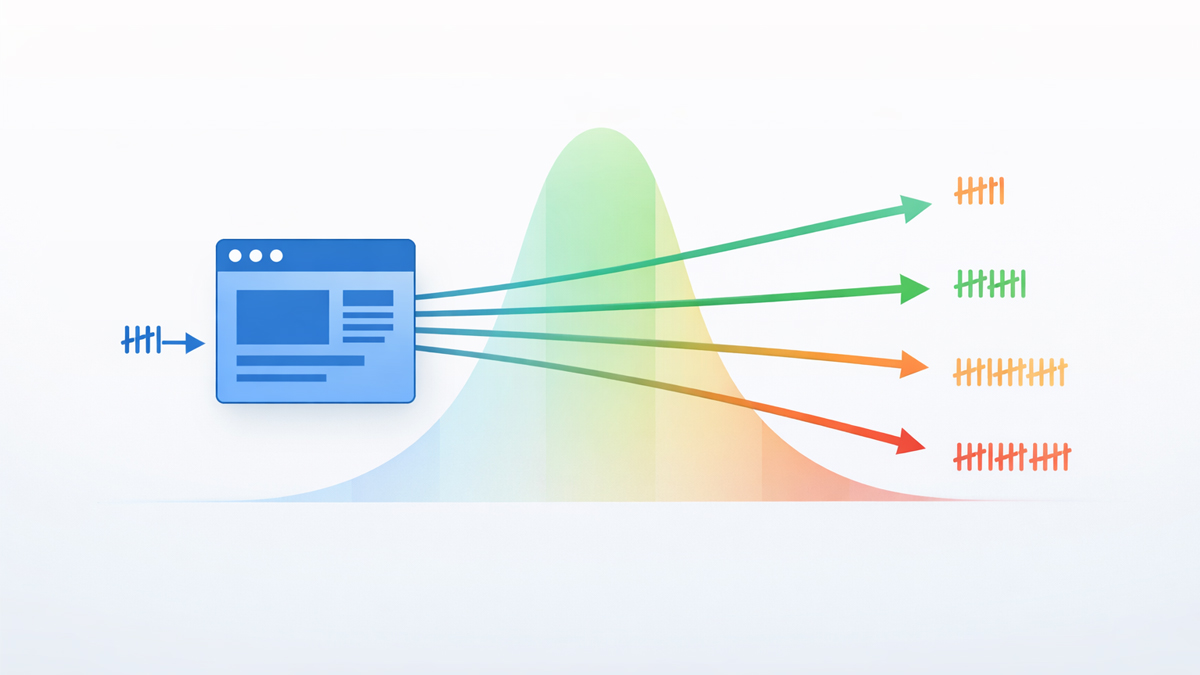
Link equity is the ranking value passed from one page to another through a hyperlink.
It splits roughly equally among all outgoing links on a page — a page with 10 links passes ~10% per link, while a page with 50 links passes ~2% each.
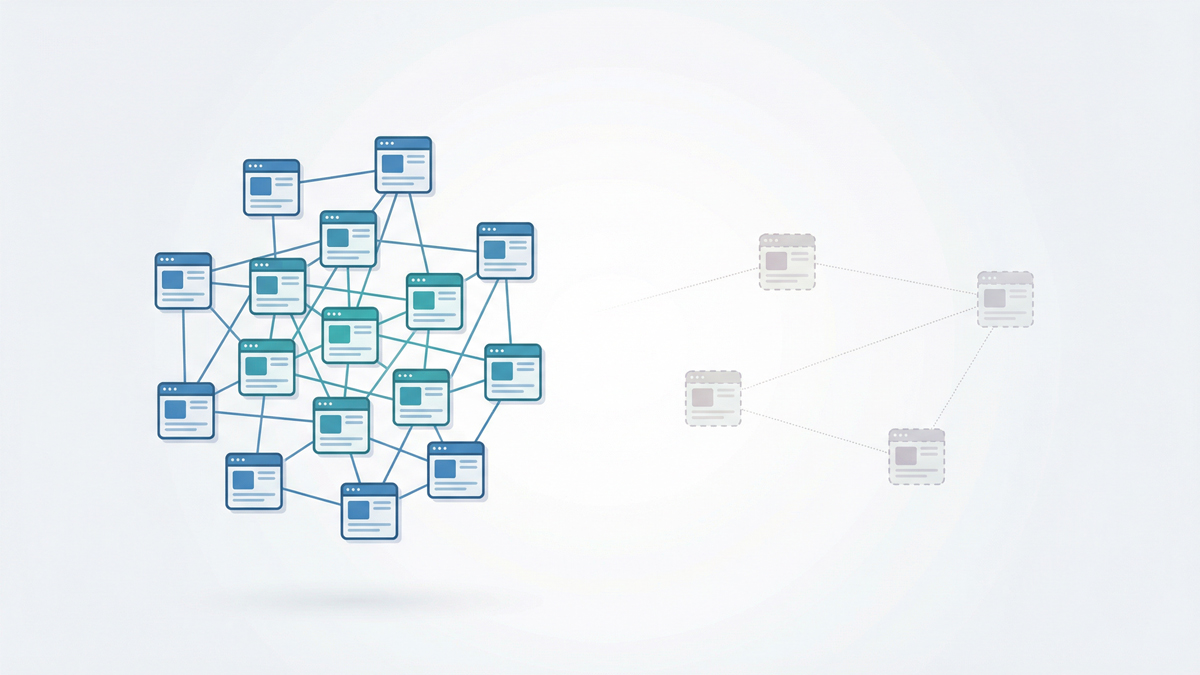
Understanding how this equity flows through your internal links is the difference between a site where authority reaches every important page and one where it pools uselessly on your homepage.
Most link equity guides focus on backlinks from external sites.
This one focuses on what happens after equity enters your domain, how it flows through internal links, where it leaks, and how to strategically route it to the pages you most want to rank.
How Link Equity Actually Works
Google's original PageRank algorithm modeled links as votes.
Each vote (link) from one page to another transferred a portion of the source page's authority to the destination.
The more authority a page had, the more valuable its votes.
The core mechanics haven't changed, even though Google no longer publishes public PageRank scores.
When a page with high authority links to another page, the destination page receives a boost.
The size of that boost depends on five factors.
1. Source page authority
A link from your homepage (which receives the most backlinks) passes more equity than a link from a deep blog post with no external backlinks.
Authority starts at pages that earn external links and flows inward from there.
2. Number of outgoing links
Equity divides among all dofollow outgoing links on the source page.
This is the dilution principle.
A page with 5 outgoing links gives each destination ~20% of its equity.
A page with 50 outgoing links gives each destination ~2%.
This is why the Zyppy study of 23 million links found traffic peaking at 45-50 links per page; beyond that threshold, each link passes so little equity it barely registers.
3. Link position
Google's Reasonable Surfer model assigns more weight to links users are likely to click.
A contextual link in the first paragraph of body content passes more equity than an identical link buried in the footer.
Editorial context matters; links surrounded by relevant text pass more value than orphaned links in navigation bars.
For the full breakdown, see our body vs footer vs sidebar link placement analysis.
4. Anchor text relevance
The clickable text of the link tells search engines what the destination page is about.
Descriptive, topically relevant anchor text passes stronger topical signals alongside the raw equity.
"Internal link checker tool" as anchor text sends a clearer topical signal than "click here."
5. Dofollow vs nofollow
Dofollow links pass equity. Nofollow links pass little to none.
Since 2019, Google treats nofollow as a hint rather than a hard directive, but the practical effect is that nofollow internal links transfer minimal equity.
Our dofollow vs nofollow guide covers the nuances in detail.
The Equity Distribution Model
Think of your website as a water system.
External backlinks are the faucets; they pump equity into your domain.
Internal links are the pipes; they route that equity to specific pages.
The pages that receive the most equity (through the most and highest-quality links) rank highest.
Your homepage is typically the central reservoir.
It earns the most backlinks, receives the most brand searches, and sits at the top of your site hierarchy.
Every internal link from the homepage routes equity to a destination page.
Those destination pages then route equity further through their own outgoing links.
The math is straightforward: If your homepage has 100 units of equity and 50 outgoing links, each linked page receives approximately 2 units.
If one of those depth-1 pages has 20 outgoing links and received 2 units of equity, each of its linked pages receives approximately 0.1 units.
By depth 3, the equity reaching any individual page is a fraction of what the homepage started with.
This is exactly why crawl depth matters so much.
Each additional click of depth doesn't just slow crawl frequency; it attenuates equity.
A page at depth 4 receives exponentially less equity than an identical page at depth 1, even if both have the same number of incoming links.
Equity doesn't disappear at each level; it redistributes.
The total equity in the system remains roughly constant (minus a small "damping factor" Google applies).
But with each link hop, equity fragments into smaller shares.
The goal of the internal link strategy is to minimize unnecessary fragmentation and ensure the largest shares flow to your highest-priority pages.
Where Link Equity Leaks
Equity leaks are pages or links that waste authority instead of routing it productively.
Every site has them.
Finding and fixing leaks is often the fastest way to improve rankings without building a single new backlink.
Leak 1: Broken Internal Links
When an internal link points to a 404 page, the equity flowing through that link vanishes.
The source page spends one of its link slots (reducing equity to other destinations), and the broken destination receives nothing useful.
According to Semrush's analysis of 10 million pages, the average website has 5-15 broken internal links.
Each one is a leak.
Fix: Run the SEOShouts Internal Link Checker to find broken links. Redirect the broken URL to the most relevant live page using a 301 redirect, or update the source page to link to the correct URL directly. For a complete fixing process, see our broken internal links repair guide.
Leak 2: Redirect Chains
Each 301 redirect in a chain loses approximately 15% of the equity passing through it, according to Moz's research on redirect equity loss.
A chain of 3 redirects (A → B → C → D) can lose 40%+ of the original equity before it reaches the final destination.
Redirect chains accumulate during site migrations, URL restructures, and content consolidations.
Fix: Audit for redirect chains with Screaming Frog or a site crawl tool. Update internal links to point directly to the final destination URL, bypassing intermediate redirects entirely. One direct link preserves maximum equity.
Leak 3: Dead-End Pages
A dead-end page has incoming links but zero outgoing internal links.
Equity flows in and stops.
The page might rank (it's receiving equity), but it hoards authority instead of distributing it to other pages that need it.
Dead-ends are the opposite of orphan pages — they receive equity but don't share.
Fix: Add 3-5 contextual outgoing links from every dead-end page. Link to related content, pillar pages, and tool pages. This converts dead-ends into equity distributors.
Leak 4: Links to Noindexed Pages
If an internal link points to a page with a noindex tag, equity flows to a page that can never appear in search results.
The equity isn't completely wasted (the noindexed page can pass equity forward through its own links), but the flow is inefficient; you're adding an unnecessary hop that attenuates the equity before it reaches indexable pages.
Fix: Avoid linking to noindexed pages unless absolutely necessary. If a noindexed page receives significant incoming links, consider whether it should actually be indexed.
Leak 5: Excessive External Outbound Links
Every external link on a page sends equity out of your domain.
External links are necessary and healthy in moderation; they signal topical relevance and editorial quality.
But a page with 30 external links and 5 internal links is exporting far more equity than it retains.
High-authority pages with lots of external links are particularly costly leaks.
Fix: Audit pages with high external-to-internal link ratios. Keep external links purposeful and limited. The ideal internal linking ratio provides benchmarks for balancing internal and external links.
How to Route Equity Strategically
Fixing leaks stops equity from being wasted. Routing equity strategically directs it intentionally to the pages you most want to rank.
Strategy 1: Identify Your Equity Sources
Your equity sources are pages that receive the most external backlinks.
In Google Search Console, go to Links → External Links → Top Linked Pages.
These are your authority hubs — the pages pumping the most equity into your domain.
Common equity sources: homepage, popular blog posts that earned media links, tools that get mentioned and linked by other sites, infographics, or original research that attracted citations.
Every internal link FROM these high-authority pages carries significant equity.
Use those links wisely.
Strategy 2: Map Your Priority Destinations
List the pages you most want to rank, typically tool pages, service pages, money pages, and pillar content.
These are your equity destinations.
Every priority page should receive internal links from multiple equity sources.
The complete internal linking guide covers how to structure this mapping as part of a full linking strategy.
Strategy 3: Create Direct Paths
The most efficient equity transfer is a direct link from a high-authority source to a priority destination.
Each intermediate page in the path attenuates the equity.
A direct link from your homepage (depth 1) to your Internal Link Checker tool page transfers far more equity than a path through 3 intermediate pages (depth 4).
Audit your priority pages and ensure each one receives at least 1-2 direct links from your highest-authority pages.
Don't rely solely on navigation — add contextual body links from authority sources for maximum equity transfer.
Strategy 4: Use Hub Pages as Equity Distributors
Pillar pages function as equity hubs.
They receive links from many sources (cluster articles, homepage, external sites) and concentrate that equity.
They then distribute it efficiently to all cluster articles through contextual outgoing links.
The hub model is why topic clusters outperform flat blog architectures for rankings.
A pillar page with 10 incoming links distributes concentrated equity to each cluster article through a single hop, rather than forcing equity through 3-4 hops of disconnected navigation.
Strategy 5: Reclaim Equity from Low-Priority Pages
Some pages on your site receive equity they don't need.
Archive pages, tag pages, and old blog posts with no target keywords may have accumulated incoming links over time.
Add contextual internal links from these pages to your priority destinations; you're redirecting their unused equity toward pages that can convert it into rankings.
Link Equity and the Reasonable Surfer Model
Google's original PageRank treated all links on a page equally.
A link in paragraph one passed the same equity as a link in the footer. The Reasonable Surfer model (patented by Google in 2004, updated since) changed this.
The Reasonable Surfer model assigns different equity values to links based on the probability that a user would click them.
Links that are more prominent, more contextually relevant, and more likely to be clicked pass more equity.
- Higher equity links: Contextual links within body content, links with relevant anchor text, links higher on the page, links surrounded by topically related text, and links that are visually prominent.
- Lower equity links: Footer links, sidebar links, navigation links that appear on every page, links with generic anchors ("click here"), links buried at the bottom of long pages.
This means not all internal links are equal, even on the same page.
A contextual link in the first paragraph of a 3,000-word article passes more equity than the same link in the footer, even though both appear on the same page and both are dofollow.
The practical takeaway: prioritize contextual body links over template-level links for equity routing. Navigation links provide crawl paths and basic equity, but body links are where the serious equity transfer happens.
Link Equity and AI Search
AI search engines (ChatGPT, Perplexity, Claude, Gemini) don't use PageRank.
But link equity still matters for AI visibility, indirectly.
AI models learn from crawled web content.
Pages that rank high in traditional search (thanks to strong equity) are more likely to appear in AI training data and retrieval datasets.
According to research, 99.5% of AI Overview sources come from the top-10 organic results.
The pages that get into top-10 positions are almost always pages with strong link equity profiles.
Additionally, AI crawlers (GPTBot, ClaudeBot, PerplexityBot) follow internal links to discover content, just like Googlebot.
Strong internal linking with semantic anchor text helps AI crawlers build accurate topical associations.
When a page receives many internal links with descriptive anchors, AI models can better understand what the page is about and when to cite it.
seoClarity's research confirms that strong internal linking structures provide AI engines with clearer semantic signals for generative results.
The equity itself doesn't flow to AI models, but the link structures that distribute equity also distribute discoverability and topical clarity to AI systems.
The takeaway: optimizing internal equity flow for Google simultaneously optimizes content discovery for AI search. You don't need a separate AI equity strategy — but you do need to ensure AI crawlers can follow your links (check your robots.txt configuration).
Measuring Link Equity Flow
Google stopped publishing public PageRank scores in 2016. You can't see exact equity values.
But several tools estimate equity per page:
Ahrefs URL Rating (UR): Estimates the link equity of a specific page on a 0-100 scale based on incoming link quantity and quality. Useful for identifying your highest-equity pages.
Moz Page Authority (PA): A similar 0-100 score estimating a page's ability to rank based on link signals. Updates regularly as link profiles change.
Semrush Authority Score: Combines link data, organic traffic, and content signals into a composite authority metric.
Google Search Console: Under Links → Internal Links, shows how many internal links point to each page. Pages with the highest incoming internal link counts typically hold the most internal equity. Under Links → External Links, shows which pages receive the most backlinks — these are your equity sources.
SEOShouts Internal Link Checker: The word cloud visualization shows anchor text distribution across your site, and the link count data reveals which pages are receiving the most and least internal equity flow.
None of these tools shows the actual PageRank.
But combined, they give you a working model of where equity concentrates and where it's thin.
Cross-reference incoming link counts (GSC) with estimated authority (Ahrefs UR) to identify pages that should be equity sources for strategic routing.
Common Link Equity Mistakes
Mistake 1: Using nofollow to "sculpt" internal equity
This hasn't worked since 2009.
When Google encounters a nofollow internal link, the equity that the link would have passed doesn't redistribute to the remaining dofollow links; it evaporates.
Using nofollow internally wastes equity.
Mistake 2: Linking every page to every other page
If every page links to every other page, equity is distributed uniformly with no concentration anywhere.
No page has more equity than any other.
This is the opposite of strategic; it's equity entropy.
Link based on relevance and priority, not completeness.
Mistake 3: Ignoring link counts on high-authority pages
Your homepage might have 80 links (navigation + footer + body).
Each link passes ~1.25% of the homepage's equity.
Trimming that to 50 links increases each link's share to ~2%, a 60% increase in equity per link.
Reducing link count on high-authority pages is one of the highest-ROI equity optimizations available.
Mistake 4: Focusing only on incoming links
A page that receives 20 incoming links but has zero outgoing links is an equity black hole.
It hoards authority.
Add outgoing links from every page to ensure equity circulates through your entire site.
Pages should be connectors, not endpoints.
Mistake 5: Ignoring redirect chains during migrations
Site migrations create redirect chains that silently drain equity. A chain of A → B → C → D loses ~40% of equity before reaching the final page.
After any migration, audit for chains and update internal links to point directly to final destinations.
Quick Reference: Equity Flow Rules
| Principle | Rule |
|---|---|
| Equity split | Divides roughly equally among all dofollow outgoing links |
| Link position | Body links > navigation > sidebar > footer (Reasonable Surfer model) |
| Depth attenuation | Each click of depth fragments equity further |
| Optimal link count | 45-50 per page for peak traffic (Zyppy study) |
| Nofollow internal | Wastes equity — always use dofollow for internal links |
| Redirect chains | Each 301 loses ~15% equity (Moz) |
| Broken links | 100% equity loss — the link passes nothing |
| Dead-end pages | Hoard equity — add 3-5 outgoing links |
| External links | Export equity out of domain — use sparingly on authority pages |
| Anchor text | Relevant anchors pass topical signal alongside raw equity |
Frequently Asked Questions
What is link equity in SEO?
Link equity (also called link juice) is the ranking value passed from one page to another through a hyperlink.
When a page with authority links to another page, it transfers a portion of that authority.
The amount depends on the source page's authority, the number of outgoing links, the link position, the anchor text's relevance, and the dofollow status.
Strong link equity is one of the most powerful ranking factors in SEO.
How does link equity split between internal links?
Equity is divided roughly equally among all dofollow outgoing links on a page.
A page with 10 links passes ~10% per link. A page with 50 links passes ~2% each.
This is why the Zyppy study found traffic peaking at 45-50 total links; beyond that, each link passes too little equity to move rankings.
Do nofollow internal links pass link equity?
Since 2019, Google treats nofollow as a hint rather than a directive.
In practice, nofollow internal links pass little to no measurable equity.
Worse, the equity that would have gone to a nofollow link doesn't redistribute to the remaining dofollow links; it's lost.
Keep all internal links dofollow unless you have a specific technical reason (login pages, checkout flows).
Where does link equity leak on a website?
Common leaks: broken internal links (404s waste equity entirely), redirect chains (each hop loses ~15%), dead-end pages with no outgoing links (equity enters but never exits), links to noindexed pages (inefficient routing), and excessive external links on authority pages (equity leaves your domain).
Run the internal link checker to find these issues.
How can I check link equity flow on my site?
Google doesn't publish PageRank scores, but Ahrefs URL Rating, Moz Page Authority, and Semrush Authority Score estimate page-level equity.
Google Search Console shows internal link counts per page (under Links → Internal Links) and external backlink distribution.
The SEOShouts Internal Link Checker shows link distribution patterns, including anchor text visualization.