Anchor text optimization is the process of selecting and structuring the clickable words in your hyperlinks to maximize SEO value, user clarity, and AI citation potential.
Done right, it passes topical relevance between pages.
Done wrong, it triggers algorithmic penalties that can drop your rankings overnight.
This guide covers the complete framework: every anchor type, the exact ratios top-ranking pages use, how to detect over-optimization, and what changes for AI search engines in 2026.
What Is Anchor Text Optimization?
Anchor text is the visible, clickable text inside a hyperlink.
When you write "check your internal link structure for free," the phrase "internal link structure" is the anchor text.
Optimization means choosing those words strategically — not randomly, not repetitively, and not stuffed with keywords.
Google uses anchor text as a primary ranking signal.
According to Google's John Mueller, "internal linking is super critical for SEO" and "one of the biggest things that you can do on a website."
The anchor text you choose tells both users and crawlers what the destination page is about before they arrive.
A 2024 study by Ahrefs analyzing 14,000 websites found that top-10 ranking pages receive an average of 44 internal links pointing to them.
But the number alone isn't what matters — the anchor text diversity across those 44 links determines whether they help or hurt.
Why Anchor Text Optimization Matters More in 2026
Three shifts have made anchor text optimization non-negotiable this year.
AI search engines read your anchors differently. ChatGPT, Perplexity, Gemini, and Google's AI Overviews use Natural Language Processing to interpret links. They don't just see the anchor text — they analyze the surrounding sentence to build semantic relationships between pages. Research from seoClarity confirms that strong internal linking structure gives AI engines clearer semantic signals for generative results.
Google's Penguin algorithm runs in real-time. Penguin no longer requires a manual update to penalize manipulative anchor text. Over-optimization triggers can hit your site within days, not months. Sites with anchor diversity below 30% see an average 15-position ranking drop, according to Authority Hacker's analysis of 100,000+ backlink profiles.
Zero-click search demands brand visibility. According to SparkToro's research, over 60% of Google searches now end without a click. Your anchor text doesn't just affect rankings — it shapes how AI models describe your brand in answers. When your internal anchor text follows semantic patterns, AI tools can extract and cite your expertise more accurately.
The 7 Types of Anchor Text (With Examples)
Every hyperlink uses one of these anchor types.
Understanding each one is the foundation of optimization.
For a deeper breakdown, see our guide on anchor text types explained.
- Exact Match — Uses the target keyword exactly as you want to rank. Example: "anchor text optimization" linking to this page. Use sparingly. High reward but equally high risk if overused.
- Partial Match — Includes the target keyword alongside other natural words. Example: "tips for optimizing your anchor text" or "anchor text best practices for 2026." This is the safest high-value anchor type.
- Branded — Uses your brand name as the anchor. Example: "According to SEOShouts" or "Rohit Sharma's research shows." Essential for entity recognition in AI search.
- Branded + Keyword — Combines brand with a descriptive term. Example: "SEOShouts Internal Link Checker" or "use the SEOShouts anchor text analyzer." Powerful because it ties your brand entity to a topic entity.
- Generic — Action phrases with zero topical context. Example: "click here," "read more," "learn more." These waste link equity entirely. According to a Semrush audit of 10 million pages, approximately 25% of internal links use generic anchors — a massive missed opportunity.
- Naked URL — Uses the raw URL as the anchor. Example: "https://seoshouts.com/tools/internal-link-checker/." Looks natural in citations and references but passes minimal topical context.
- Image Alt Text — When an image is hyperlinked, the alt attribute functions as anchor text. Google Search Central documentation confirms this explicitly. Ensure every linked image has a descriptive, keyword-relevant alt tag.
The Ideal Anchor Text Ratio: Data From Top-Ranking Pages
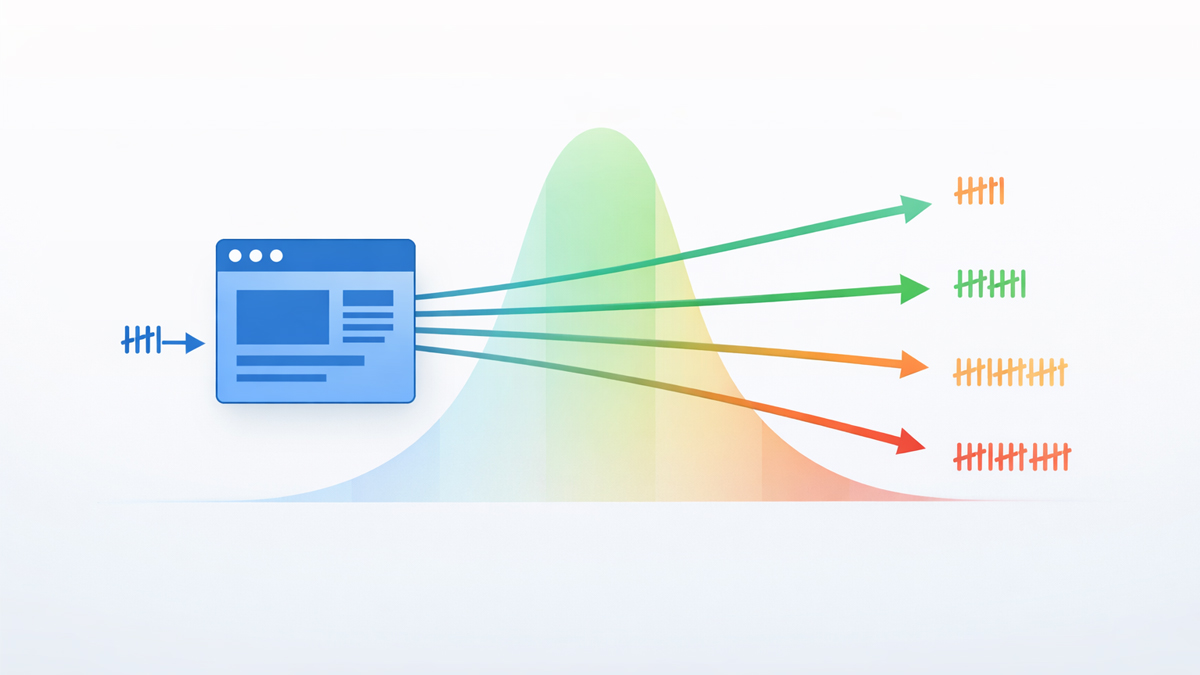
There is no universal "perfect" ratio — it shifts by niche, domain authority, and page type.
But analysis of top-ranking pages reveals consistent patterns.
| Anchor Type | Recommended Ratio | Risk Level | AI Signal Value |
|---|---|---|---|
| Descriptive / Partial Match | 50–60% | Low | High — provides semantic context |
| Branded | 20–25% | Very Low | High — builds entity recognition |
| Exact Match | 10–15% | Moderate | Medium — use carefully |
| Naked URL | < 5% | Very Low | Low — no context for AI |
| Generic ("click here") | < 5% | Low | Zero — actively harmful |
These percentages apply specifically to internal links, where you have complete control.
For backlinks (external links pointing to your site), the tolerance for exact-match anchors is lower — typically under 5-8% for competitive niches.
The ideal internal linking ratio article covers the broader link count calculations.
What the data shows: Authority Hacker found that sites maintaining anchor diversity above 70% (meaning no single anchor type exceeds 30% of total) consistently outperform sites with concentrated anchor profiles. Databox survey data shows 42% of SEOs spend equal time on internal and external link optimization — the other 58% are leaving traffic on the table.
Why domain age matters: Matt Diggity's testing confirms that newer domains need even more conservative ratios. A 6-month-old site using 15% exact-match anchors faces significantly higher penalty risk than a 10-year-old domain using the same ratio. If your site is under 2 years old, keep exact-match anchors below 8%.
How to Optimize Anchor Text: A Step-by-Step Process
Step 1: Audit Your Current Anchor Profile
Before changing anything, see what you're working with.
Run your site through the SEOShouts Internal Link Checker — it crawls up to 500 pages and generates a visual word cloud of your anchor text distribution.
No other free tool offers this visual breakdown.
What to look for in your word cloud:
- A healthy cloud shows a mix of word sizes — your brand name appears large, several descriptive variations appear medium-sized, and dozens of natural phrases appear small.
- A toxic cloud has one massive keyword dominating the center with everything else barely visible.
If you need a broader site health check, pair the anchor analysis with an on-page SEO audit to see how your anchor strategy aligns with overall page optimization.
Step 2: Map Your Target Pages and Keywords
List every page you want to rank, paired with its primary keyword.
Then assign 5-8 anchor text variations per page.
Example for a page targeting "technical SEO audit":
- "comprehensive technical SEO audit" (partial match)
- "run a full site audit" (partial match, different angle)
- "SEOShouts technical audit" (branded + keyword)
- "audit your site's technical health" (descriptive)
- "identify crawling and indexing issues" (benefit-focused)
- "our technical audit process" (generic-branded hybrid)
The rule: if 10 pages link to one target URL, use 10 different anchors.
Never repeat the same anchor text for the same destination across multiple pages.
This principle is documented in detail in our anchor text best practices guide.
Step 3: Write Anchors That Read Naturally
Google's AI uses BERT and MUM to analyze the full sentence around your link — not just the anchor text itself.
The surrounding context determines how much weight the anchor carries.
- Bad: "We offer SEO consulting. For your anchor text optimization needs, contact us about anchor text optimization services."
- Good: "If your link profile shows signs of keyword stuffing, a professional anchor text audit can identify exactly which links to rewrite."
The second version tells both users and AI why the link exists, what value it provides, and what to expect on the other side.
This is the core principle of semantic anchor text writing — context over keywords.
Step 4: Fix Generic and Naked URL Anchors
Search your content for every instance of "click here," "read more," "learn more," and raw URLs used as links.
Replace each one with descriptive text.
| Before (Generic) | After (Optimized) |
|---|---|
| "Click here for more info" | "See how link equity flows through your site structure" |
| "Read more" | "Learn why orphan pages get zero organic traffic" |
| "https://seoshouts.com/tools/" | "Explore 15 free SEO tools built for technical optimization" |
Every generic anchor you fix is free ranking equity you're currently wasting.
Step 5: Check for Over-Optimization Signals
After rewriting, audit again. These red flags signal over-optimization:
Any single exact-match phrase appears on more than 15% of your linking pages.
The same anchor text is repeated across 3+ pages for the same destination URL.
Your anchor cloud shows less than 5 distinct phrases for a high-priority page.
More than 30% of all anchors site-wide are exact-match keywords.
If you spot these patterns, dilute by replacing 20-30% of the offending anchors with branded or descriptive alternatives.
The over-optimization detection guide covers recovery steps in detail.
Internal Links vs External Links: How Anchor Strategy Differs
Anchor text optimization is not one-size-fits-all.
The rules change based on whether you're linking within your own site or receiving links from other domains.
Our detailed comparison of internal vs external link strategies breaks down the full ecosystem, but here's the anchor-specific difference:
Internal links (you control these):
- Higher tolerance for exact-match anchors (10-15% is acceptable)
- Every anchor should be intentionally chosen
- Vary anchors even when linking to the same page from multiple articles
- Contextual placement in body content passes more weight than footer or sidebar links
- Use the internal link checker monthly to catch drift
External links (backlinks from other sites):
- Keep exact-match anchors under 5-8%
- You can't directly control anchor text, but you can influence it through outreach
- Monitor your backlink anchor profile for sudden spikes in exact-match keywords
- Disavow links with obviously manipulative anchors
The key insight: internal anchor optimization is the highest-ROI SEO activity because you control it completely.
You can restructure your entire anchor profile today without sending a single outreach email or spending a dollar.
How AI Search Engines Use Your Anchor Text
This is the 2026 differentiator most guides ignore entirely.
Traditional Google crawlers read anchor text as a keyword signal — "this link says 'SEO audit' so the destination page is about SEO audits." Simple matching.
AI models like GPTBot, ClaudeBot, and PerplexityBot process anchor text differently.
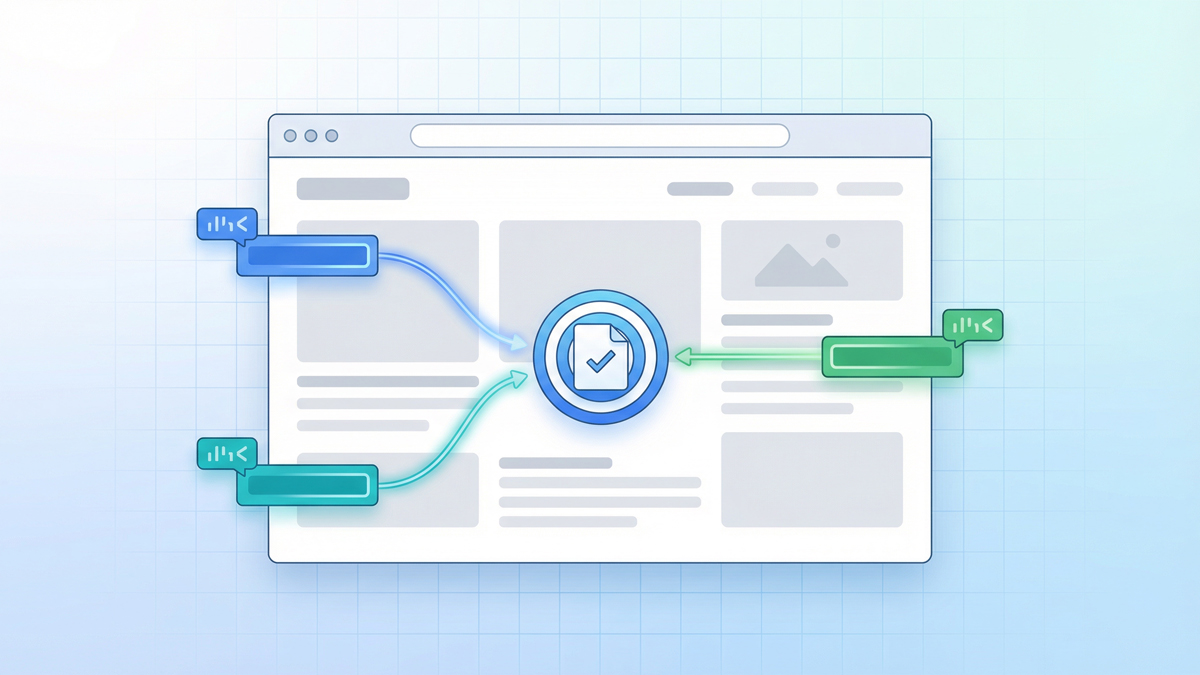
They use vector embeddings to map the semantic relationship between the source page, the anchor phrase, the surrounding sentence, and the destination page.
All four elements must align for the AI to build a confident topical connection.
According to Yoast's internal linking research, internal links in the AI era "are no longer mere SEO signals, but context signals that shape how AI models understand your topics."
This means your anchor text literally teaches AI models what your site is about.
What this means for your strategy:
Write anchors that describe the destination page's value, not just its keyword.
"How to find and fix orphan pages on your site" is a better anchor than "orphan pages" because it tells the AI what the reader will learn — and that context becomes part of the semantic map.
For a complete breakdown of how AI crawlers parse your link structure, see how AI crawlers use internal links.
Want to see your anchor text the way AI sees it?
The word cloud visualization in our internal link checker gives you the closest visual approximation of how AI models weight your anchor phrases.
Larger words in the cloud = stronger topical signals to AI.
Common Anchor Text Mistakes (And How to Fix Them)
Mistake 1: Using the same anchor for every link to one page.
If 8 blog posts all link to your pillar page using "internal linking guide," Google sees manufactured uniformity.
Fix: create 8 unique variations that each describe a different aspect of the pillar content.
Mistake 2: Ignoring image link alt text.
Linked images without alt text create empty anchors — equivalent to linking the word "nothing."
Audit every clickable image and add descriptive alt attributes.
Mistake 3: Stuffing anchors into unrelated content.
A paragraph about email marketing that suddenly links to "best anchor text optimization tool" looks manipulative.
Links must fit the surrounding content naturally.
Mistake 4: Never updating old anchors.
Articles published in 2022 with outdated anchor text still pass signals today.
During your monthly internal link audit, review anchors on your top 20 traffic pages and refresh any that use generic phrases or outdated terminology.
Mistake 5: Nofollowing internal links to "save link equity."
This is a persistent myth. Adding nofollow to internal links doesn't redirect equity to other links — it just destroys the equity that link would have passed.
As covered in our dofollow vs nofollow guide, keep all internal links dofollow unless you have a specific technical reason (user-generated content, login pages).
Tools for Anchor Text Analysis
You don't need expensive software to audit your anchor text. Here's what works:
Free tools:
- SEOShouts Internal Link Checker — Visual word cloud of anchor text distribution, covers up to 500 pages, no login required. The word cloud instantly reveals over-optimization patterns that spreadsheets hide.
- Google Search Console — Shows external anchor text (backlinks) pointing to your site under Links > Top Linking Text.
- Screaming Frog (free tier) — Crawls up to 500 URLs with anchor text data in table format.
Paid tools:
- Ahrefs — Comprehensive backlink anchor analysis with historical data. Starting at $99/month.
- Semrush — Backlink anchor report with over-optimization warnings. Starting at $139/month.
- Screaming Frog (paid) — Unlimited crawl with exportable anchor reports. $259/year.
For a side-by-side feature comparison, see our roundup of the best internal link checker tools.
The key advantage of visual analysis: spreadsheets show you data. Word clouds show you patterns.
A word cloud can reveal in 2 seconds what takes 20 minutes to spot in a CSV — one keyword dominating your entire link profile.
Anchor Text Optimization by Page Type
Different pages require different anchor strategies. Here's how to adjust:
Blog posts and articles: Use primarily descriptive and partial-match anchors. Blog content should link contextually within paragraphs, not in isolated "related posts" blocks. Aim for 3-5 internal links per 1,000 words, following the ideal link density framework.
Tool pages and product pages: Branded + keyword anchors perform strongest here. "Try the SEOShouts schema generator" is stronger than "schema tool" because it associates the brand entity with the product entity.
Service pages: Mix descriptive anchors with location-based variations for local SEO. "Technical SEO audit for ecommerce sites" and "enterprise site architecture review" both point to the same service page but capture different search intents.
Pillar pages: These should receive the widest variety of anchors since they attract links from many cluster articles. Our topic cluster architecture guide explains how to structure bidirectional linking between pillar and cluster content.
Your Anchor Text Optimization Checklist
Use this before publishing any page or during monthly audits:
Every internal link uses descriptive anchor text (zero "click here" or "read more")
No single exact-match phrase exceeds 15% of anchors pointing to one page
Each target URL receives at least 5 unique anchor text variations
Anchors read naturally within their surrounding sentences
Image links have descriptive alt text that functions as anchor text
Internal links are all dofollow (no unnecessary nofollow attributes)
Anchor text accurately describes the destination page's content
No identical anchor text repeated for the same URL across multiple pages
Site-wide anchor diversity exceeds 70% (no type dominates above 30%)
Anchors include natural language phrasing for AI semantic parsing
Word cloud visualization confirms balanced distribution (no single dominant keyword)
Old content (6+ months) has been audited for outdated or generic anchors
Frequently Asked Questions
What is the ideal anchor text ratio for SEO in 2026?
Based on analysis of top-ranking pages, aim for 50-60% descriptive/partial match, 20-25% branded, 10-15% exact match, and less than 5% each for generic and naked URL anchors.
Sites with anchor diversity below 30% see an average 15-position ranking drop according to Authority Hacker research.
How do I check if my anchor text is over-optimized?
Run your site through an anchor text analyzer with word cloud visualization.
If any single phrase accounts for more than 15% of your total anchors, or if your exact-match ratio exceeds 20%, your profile is likely over-optimized.
Visual word clouds make over-optimization immediately obvious.
Does anchor text still matter for SEO rankings?
Absolutely. Google's John Mueller confirmed that internal linking is "super critical for SEO."
Anchor text is the mechanism that tells search engines what each linked page is about.
In the AI era, this extends further — AI models use anchor text context to build semantic maps of your entire site, directly impacting whether they cite your content in generated answers.
Should anchor text be different for internal vs external links?
Yes. Internal links tolerate slightly higher exact-match usage (10-15%) because you control the context.
Backlink anchors should keep exact-match under 5-8% since Google's Penguin algorithm specifically monitors external anchor patterns for manipulation signals.
The strategies diverge further depending on your domain's age and authority.
How many different anchor text variations should point to one page?
Aim for at least 5-8 unique variations for every important page.
If 10 pages link to one target, use 10 different anchors.
Repeating the same anchor text across multiple linking pages signals manipulation and reduces the topical richness of your internal link graph.
Can changing anchor text hurt my current rankings?
It can if you change too much at once. Rewrite anchors gradually — update 10-15 links per week rather than hundreds overnight.
Prioritize fixing generic anchors first (lowest risk, highest reward), then diversify exact-match anchors over time.
Monitor rankings for 2-3 weeks after each batch of changes.
What anchor text should I use for AI Overviews?
AI models prefer anchors that describe what the reader will learn, not just the topic keyword.
"How to audit your internal links in 5 minutes" outperforms "internal link audit" because the descriptive version gives the AI enough context to extract and summarize your content.
Our guide on anchor text for AI search covers this in depth.